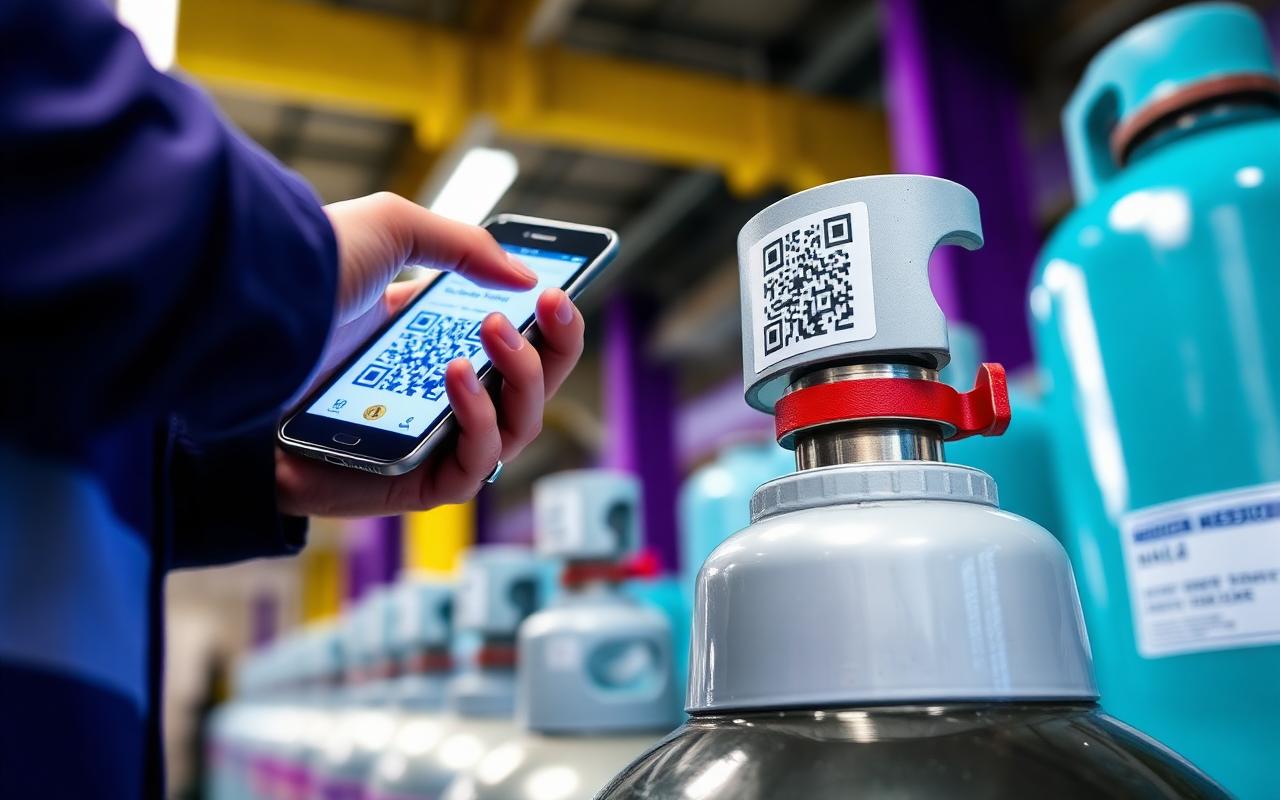
QR Code Cylinder Tracking: A Practical Playbook
QR codes have become the most accessible way to give a physical cylinder a digital identity. Any smartphone camera can read one instantly, no dedicated scanner hardware is required, and a single code can link to a rich, constantly-updated lifecycle record rather than a static number. For gas distributors weighing up tagging technology, QR sits in a sweet spot: dramatically better than a stencilled serial number, and far cheaper and faster to deploy at scale than RFID. This playbook walks through a complete, practical QR rollout — from the underlying concept through label selection, placement, scanning workflow design, staff adoption, and how QR fits alongside other tracking technologies.
The digital passport concept
Think of each QR code not as a label but as a passport. Scanning it does not simply confirm "this is cylinder #4821" — it opens a live record showing the cylinder's manufacture date, gas type, cylinder specification (water capacity, working pressure, tare weight), full hydrostatic test history, current holder, current location, and its entire movement history back to the day it entered your fleet.
This matters because a serial number alone answers only "what is this," while a digital passport answers "is this cylinder safe to fill, who is legally responsible for it right now, and when does it next need testing" — all from a single tap, in the field, without needing to call the office or dig through a filing cabinet. For any medical gas operator in particular, this instant verifiability is not a convenience but a compliance necessity: knowing with certainty that a specific cylinder passed its most recent hydro test, before it goes anywhere near a hospital ward, is exactly the kind of check a QR-linked passport makes trivial and a paper record makes slow and error-prone.
Why QR rather than a plain serial number or barcode alone
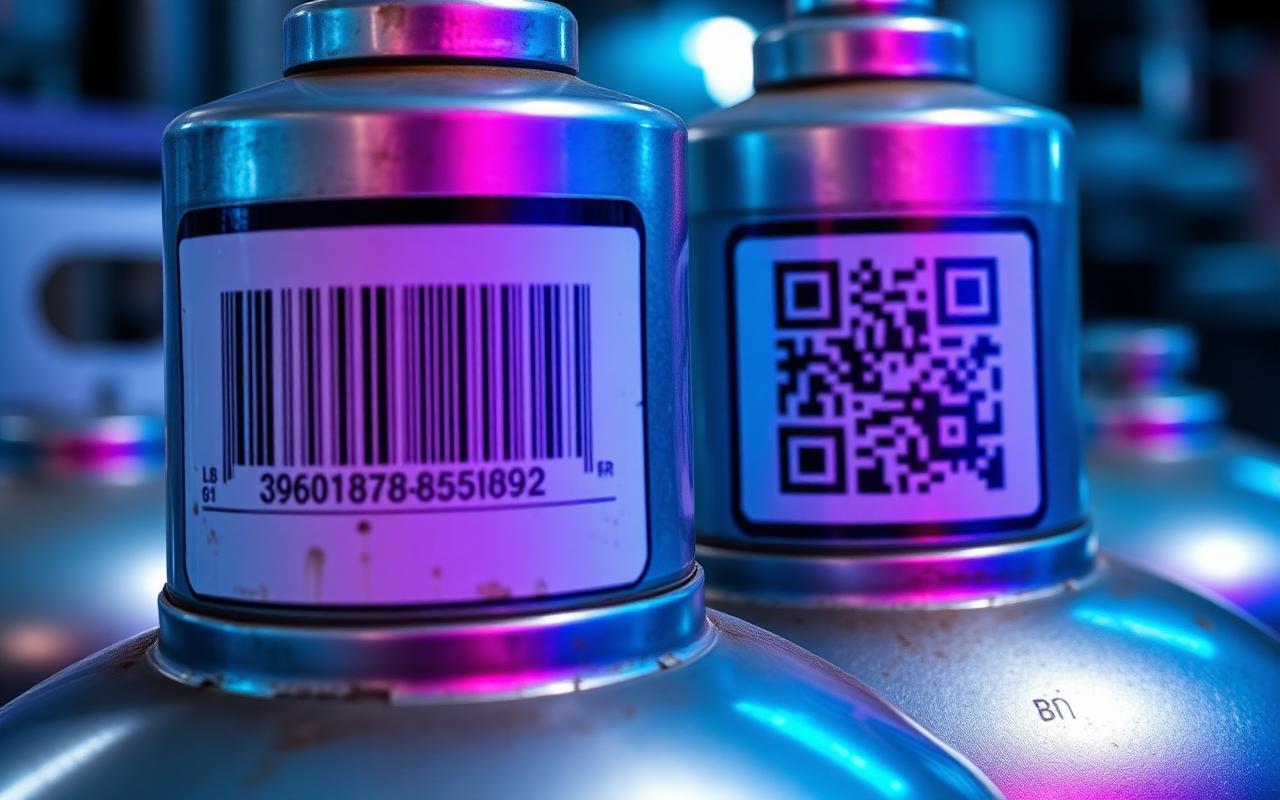
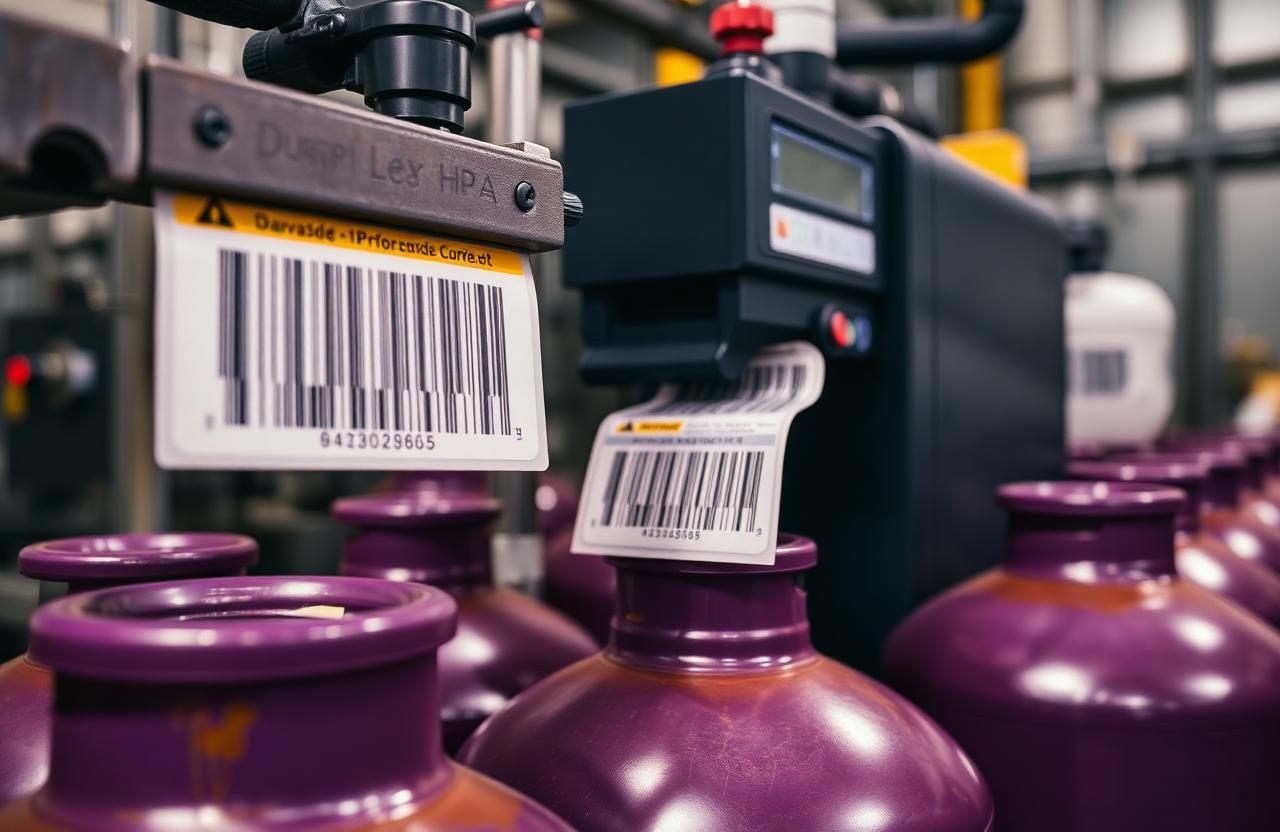
A traditional 1D barcode can encode a serial number efficiently and is perfectly serviceable for many operations, but it typically requires a dedicated barcode scanner or at minimum a scanner-emulation app, and it holds very little data directly in the code itself — everything has to be looked up centrally. A QR code holds substantially more data density, can be read reliably by any modern smartphone camera without special hardware, and depending on how it is structured can even encode a fallback subset of key information directly in the code, so that some information remains accessible even in a momentary network outage in the field.
Choosing durable labels
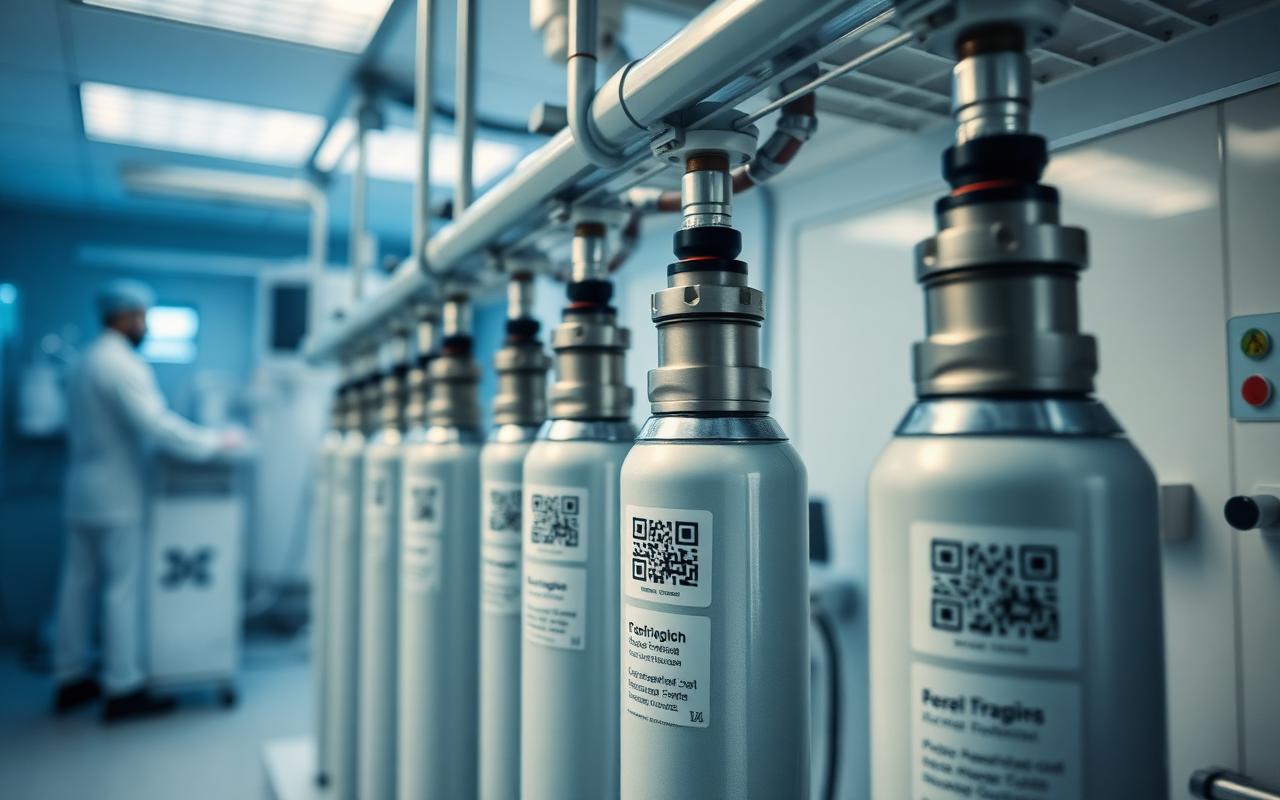
Cylinders live hard lives — they are dropped, dragged, exposed to rain, sun, oil, chemical splashes, and repeated handling by workers wearing heavy gloves. A QR code that looks perfect on the day it is printed and peels or fades within six months is worse than no code at all, because it creates a false sense of a tracking system that is quietly degrading in the background.
- Use industrial-grade, weather- and solvent-resistant label stock, not standard office label paper, even for an initial pilot batch.
- Apply a protective laminate or use a pre-laminated label material rated for outdoor UV exposure over multi-year timeframes.
- Test adhesion on your actual cylinder finish before committing to a mass rollout — powder-coated, galvanized and bare-metal cylinder surfaces all bond differently with adhesive labels, and a label that adheres perfectly to one finish may peel within weeks on another.
- Consider engraved or laser-etched QR codes directly on a metal tag riveted to the cylinder for high-value or long-life assets, where the marginal extra cost per unit is justified by decades of expected service life.
- Where labels are used, specify a minimum print resolution and quiet-zone margin so the code remains scannable even after some surface wear — a QR code with excessive wear at the edges but an intact core data pattern can often still be read, provided the original print quality and margin were generous.
Placement matters more than most operators expect
Where you physically place the code has a large, compounding effect on both scan speed and code survival over the cylinder's working life.
- Place codes on the shoulder or a dedicated collar tag where they remain visible when the cylinder is standing upright in a typical storage rack, rather than low on the body where they get scuffed against the ground or other cylinders.
- Avoid placement near the valve or handling points where friction and repeated grip contact will wear the label fastest.
- Maintain strict consistency of placement across the entire fleet — a driver or warehouse worker who knows exactly where to look for the code on every cylinder type scans dramatically faster than one who has to hunt for it, and this speed difference compounds across thousands of daily scans into a real productivity difference.
- For cylinders that get repainted or refurbished periodically, build re-tagging into that same workflow so a code is never accidentally painted over and rendered permanently unreadable.
Designing scanning workflows around real handoffs
A QR code only has value if it actually gets scanned at every meaningful point in the cylinder's journey. Define explicit scan points, and make each one a single, fast tap rather than a multi-step data entry exercise:
- Filling — scanned before filling begins, both to log the fill event against the correct cylinder and to block filling automatically if that cylinder's test certification has lapsed.
- Dispatch — scanned as it is loaded onto a delivery vehicle, building an accurate manifest without a separate paper loading list.
- Delivery — scanned at the customer site through a driver mobile app, ideally alongside a GPS location capture and customer signature or OTP confirmation.
- Return — scanned the moment it comes back through the gate, immediately updating the customer's holding ledger and stopping any demurrage clock.
- Testing and maintenance — scanned when a cylinder goes in for hydrostatic testing or valve servicing, logging the event and automatically updating the next-due date.
- Inter-depot transfer — scanned on both the outbound and inbound side of any movement between facilities, so responsibility and location always match reality.
Each of these scans should update the cylinder's status automatically in the background — no separate form to fill in, no secondary system to update manually. The entire value of QR-based tracking evaporates the moment scanning becomes a two-step "scan, then also type in a report" process, because staff under time pressure will very predictably skip the second step first.
Handling the offline and field-connectivity problem
Gas distribution routes often run through areas with patchy mobile connectivity — industrial estates, rural delivery zones, basement loading docks. A QR-based system needs to gracefully handle scans made with no live network connection, queuing them locally on the device and syncing automatically the moment connectivity returns, rather than failing the scan outright or forcing the driver to manually re-enter it later from memory. This offline resilience is one of the most important, and most commonly overlooked, criteria when evaluating a driver mobile app for field scanning.
Driving staff adoption
The best QR system in the world fails if drivers and warehouse staff quietly route around it under time pressure. A few practical adoption principles matter more than the technology choice itself:
- Make scanning faster than the alternative, not just more accurate — if scanning takes longer than writing a number on a clipboard, staff will revert to the clipboard the first time they are running behind schedule.
- Train on the "why," not just the "how." Staff who understand that a scan protects them from being blamed for a cylinder they never actually received are far more likely to scan diligently than staff who see it as pure management surveillance.
- Start with a pilot route or depot rather than a full fleet rollout on day one, and use the pilot to fix workflow friction before it gets replicated across the whole operation.
- Make exceptions visible and quickly resolvable — a driver who hits a scanning error in the field needs a fast, simple override path (with appropriate audit logging) rather than being stuck unable to complete a delivery.
QR versus barcode versus RFID
| Factor | Barcode (1D) | QR code | RFID |
|---|---|---|---|
| --- | --- | --- | --- |
| Reader hardware | Dedicated scanner usually needed | Any smartphone camera | RFID reader required |
| Data capacity | Low (typically just an ID) | Moderate to high | Moderate, plus read/write memory |
| Line of sight required | Yes | Yes | No |
| Bulk/hands-free scanning | No | No | Yes, multiple tags at once |
| Typical cost per tag | Very low | Very low | Higher |
| Durability in harsh environments | Good with proper label stock | Good with proper label stock | Excellent, can be embedded |
| Best fit | Simple, low-volume ID needs | Field verification with rich data, smartphone-based ops | High-throughput gate/warehouse reads |
QR holds meaningfully more data than a basic 1D barcode and needs no special reader — a genuine advantage for field teams who already carry a smartphone for every other part of their job — but it still requires line of sight and a deliberate scan action for every single cylinder. For high-volume, hands-free scenarios such as a truck driving through a gate with fifty cylinders loaded, or a warehouse cycle count across an entire rack in seconds, RFID wins decisively because multiple tags can be read simultaneously without individually presenting each one to a reader.
Many mature operators end up combining both: QR or barcode for cost-effective, universal cylinder identity and field verification via Cylinder QR Tracking, layered with RFID at specific high-throughput choke points like plant gates and warehouse dispatch bays via Cylinder RFID Software, getting the cost advantage of QR everywhere it is sufficient and the speed advantage of RFID exactly where volume actually demands it.
Implementation roadmap
- Audit your current identity coverage. Determine what proportion of your active fleet already has any form of scannable ID versus stencilled or unmarked cylinders.
- Select label stock and run a durability pilot. Apply candidate labels to a sample batch across different cylinder finishes and expose them to real operating conditions for at least four to six weeks before committing to a full print run.
- Standardise placement and print specifications. Document exact placement position, minimum code size, and print resolution so that every future tagging batch — including new cylinder purchases — is consistent from day one.
- Tag the active fleet in batches, prioritising your highest-turnover cylinders first since they generate the fastest data quality improvement.
- Deploy the scanning app to a pilot team, covering filling, dispatch and delivery scan points, and gather feedback on workflow friction before wider rollout.
- Expand scan points to returns, testing and transfers, closing the loop across the full cylinder lifecycle.
- Review scan compliance weekly during rollout, identifying any handoff point where scan rates are lagging and addressing the workflow or training gap immediately rather than letting it become a permanent habit.
Frequently asked questions
Do QR codes wear out faster than barcodes on cylinders? Not inherently — durability depends almost entirely on label material and lamination quality, not the code type itself. A well-specified QR label and a well-specified barcode label degrade at similar rates under the same conditions.
Can a damaged or partially worn QR code still be scanned? Often yes, because QR codes include built-in error correction that allows a meaningful percentage of the code to be unreadable while still decoding correctly, provided the original print quality and quiet-zone margin were adequate — another reason not to cut corners on label specification.
Is a QR-based system enough for regulatory compliance, or do we need RFID for that? For most compliance requirements — proof of hydro test history, fill records, and chain of custody — a well-implemented QR system tied to a proper cylinder compliance workflow is entirely sufficient. RFID adds scanning speed and hands-free bulk reads, not additional compliance capability by itself.
How long does a typical QR tagging rollout take for an existing fleet of 10,000+ cylinders? Most distributors complete initial tagging of an active fleet this size within 8 to 12 weeks when tagging is done in batches alongside normal cylinder circulation, rather than trying to pull every cylinder out of service simultaneously for a one-time tagging exercise.
Getting started
QR tagging is one of the fastest, lowest-cost ways to move from a fleet of anonymous cylinders to a fully traceable digital fleet, and it pairs naturally with a broader gas cylinder tracking platform that turns every scan into an automatically updated lifecycle record rather than an isolated data point. Dig deeper with our comparison of RFID vs barcode cylinder tracking, explore Cylinder QR Tracking and the underlying QR Code technology, or book a demo to see a QR-based rollout plan built around your specific fleet and label requirements.
Explore related GCT software
Put the ideas in this article into practice with the GCT modules and technologies built for it.
Run a smarter cylinder fleet with GCT
GCT gives gas companies barcode, QR & RFID tracking, automated billing, compliance dashboards and a mobile field app — all in one platform.
Running an enterprise gas distribution operation? Explore the Cylinder Tracking Management System at ctmsgas.com for enterprise-grade cylinder ERP deployments.