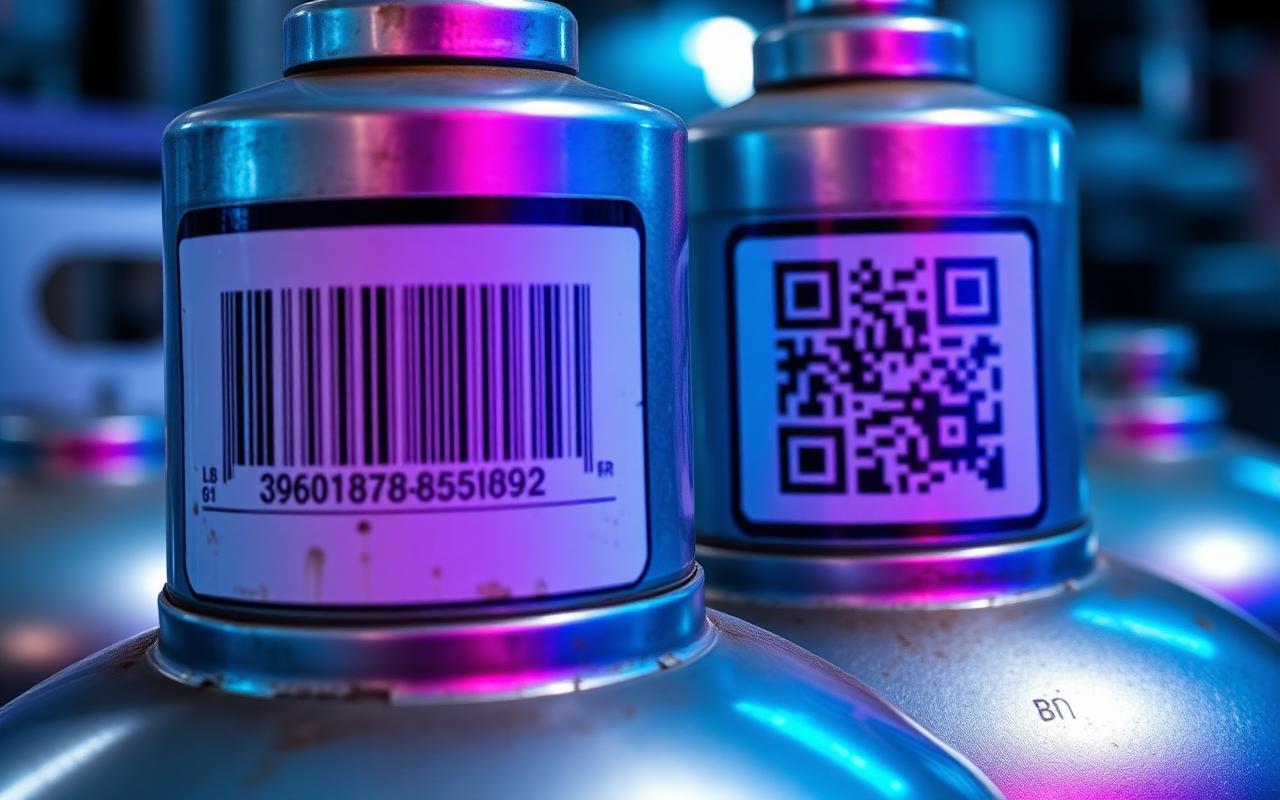
Barcode vs QR Code Cylinder Labels: Which Should You Use?
Both barcodes and QR codes give a gas cylinder a scannable digital identity, and on the surface the choice between them looks like a minor technical detail. In practice, it is a decision that ripples through your hardware budget, your field team's daily workflow, your customer experience, and even your ability to withstand years of exposure to rust, grease, and weather in an outdoor cylinder yard. This guide walks through the real differences between the two technologies, when each makes sense, and why most mature gas distribution operations end up using both rather than picking a single winner.
Starting from the basics: what each technology actually does
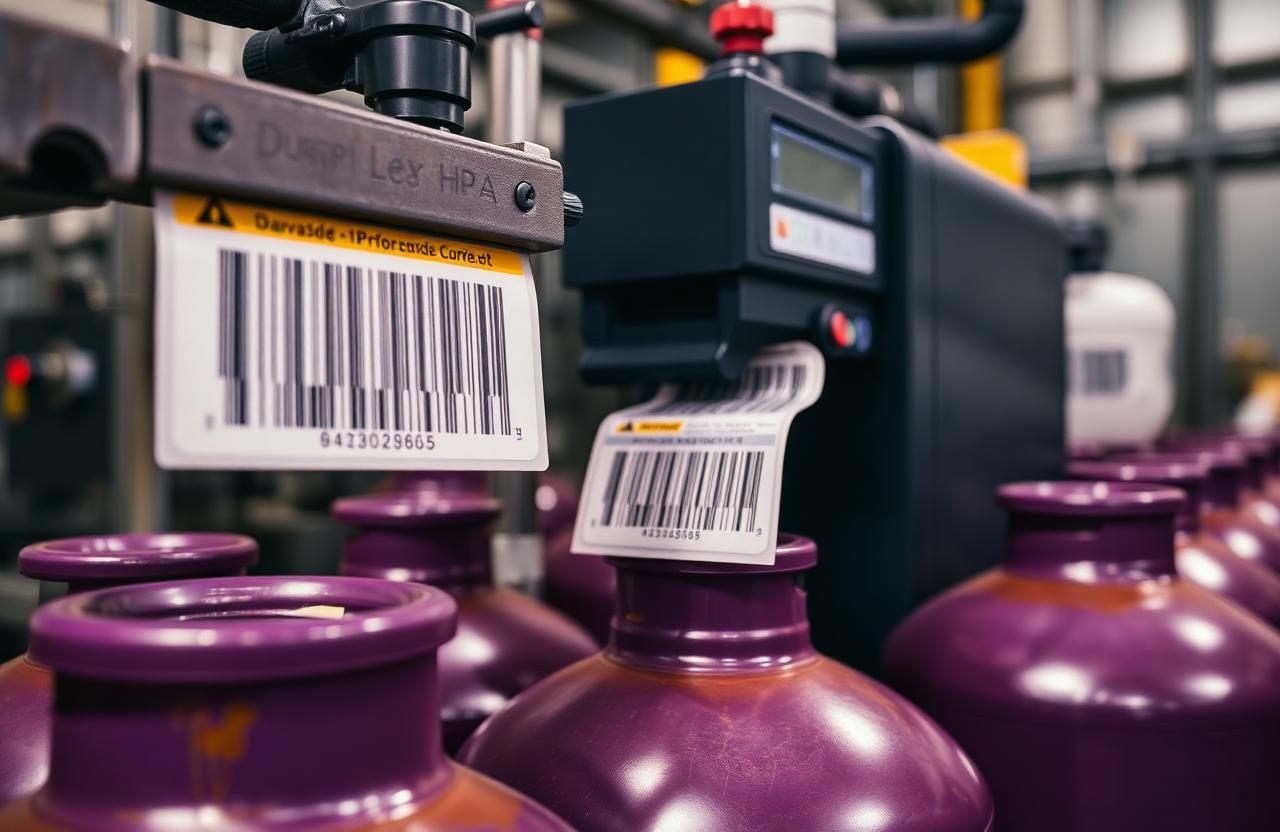
A barcode, in the traditional 1D sense familiar from retail checkout counters, is a series of parallel lines of varying width that encode a short string of characters — typically just enough to serve as a unique identifier or lookup key. The barcode itself carries almost no information beyond that key; everything meaningful about the cylinder — its fill history, current location, test dates, ownership, and status — lives in the backend database and is retrieved by looking up that key.
A QR code, a form of 2D matrix barcode, works differently. Because it encodes information in a two-dimensional grid rather than a single line of bars, it can hold vastly more data — potentially several kilobytes of text — and is commonly used to embed a full URL that opens directly to a web page containing the cylinder's digital passport, rather than requiring a backend lookup at all. This structural difference is the root of nearly every practical distinction between the two technologies.
Data capacity: lookup key versus digital passport
A 1D barcode's job is to be a lookup key — nothing more. It is deliberately minimal, which is part of its strength in high-speed environments where the scanning system already has network access to a central database and just needs a fast, reliable identifier. A QR code, by contrast, can store enough data to function independently of a live database connection if needed, and more commonly is used to link directly to a hosted digital record that anyone with a smartphone can open in a browser without installing any special app.
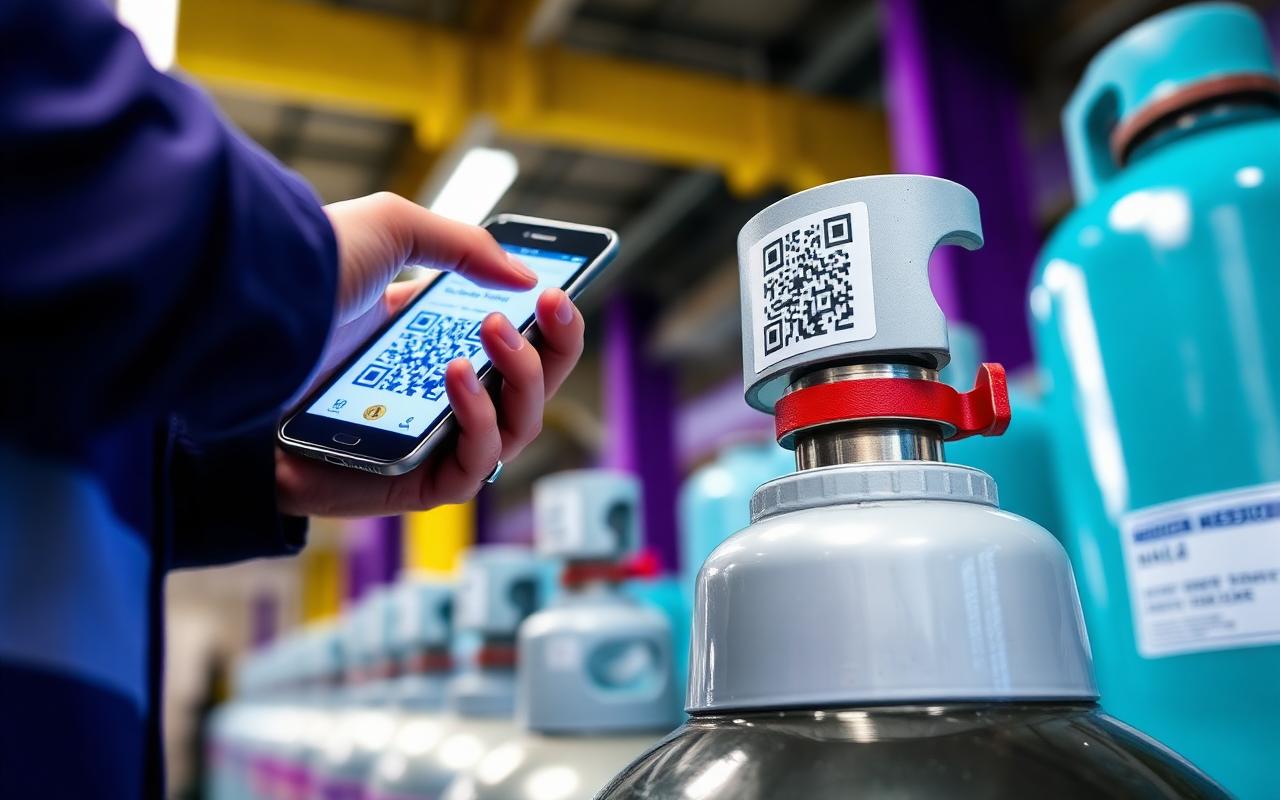
For a gas cylinder specifically, this distinction matters because cylinders often get scanned by people who are not logged into your internal system at all — a customer's warehouse staff checking a delivery, a hospital ward attendant verifying an oxygen cylinder, or a regulator conducting a spot inspection. A QR code that opens a public-facing summary of the cylinder's key safety data serves these audiences far better than a barcode that only means something to someone with access to your internal software.
Scan hardware: dedicated scanners versus any smartphone
Barcodes scan fastest and most reliably with dedicated laser or CCD scanners, which remain the gold standard for high-volume environments like a filling line, where hundreds of cylinders move past a fixed scanning point every hour and speed matters more than anything else. These scanners are inexpensive, extremely durable, and can read a barcode in a fraction of a second even at odd angles or in low light, which makes them ideal for a controlled industrial setting where the same trained operators use the same equipment every shift.
QR codes, by contrast, scan reliably with any modern smartphone camera, requiring no dedicated hardware investment at all. This is a major advantage for field staff, delivery drivers, and — crucially — customers who will never own a barcode scanner but almost certainly carry a smartphone. A Driver Mobile App built around QR scanning turns every delivery vehicle into a fully capable scanning station without a single piece of extra hardware, while a Customer Portal can let end customers verify a cylinder's status simply by pointing their phone at the label.
| 1D Barcode | QR Code | |
|---|---|---|
| --- | --- | --- |
| Data stored | Short ID string, typically a lookup key | Larger payload, often a full URL or record |
| Ideal scan hardware | Dedicated laser/CCD scanner | Any smartphone camera |
| Scan speed at high volume | Very fast, purpose-built | Fast, slightly slower at extreme volume |
| Customer/field accessibility | Low — needs special hardware | High — no special hardware needed |
| Damage tolerance | Fails if a line is obscured | Built-in error correction tolerates damage |
| Typical best use case | Filling line, warehouse dispatch | Field service, customer self-service, medical gas |
| Label cost | Low | Low, roughly comparable |
| Setup complexity for offline lookup | Requires live database connection | Can work with cached or embedded data |
Durability in harsh cylinder environments
Whichever code type you choose, the physical label itself has to survive conditions that would destroy an ordinary printed sticker within weeks: direct sun exposure, rain, mud, oil and grease from handling equipment, repeated contact with rough concrete yards, and in some industrial gas settings, exposure to corrosive residues. This means the underlying label material — polyester, anodised aluminium, or specialised industrial-grade vinyl with a protective laminate — matters at least as much as the code type printed on it.
Where the code type does make a real difference is in tolerance for partial damage. A traditional 1D barcode is essentially a sequential read — if a section of the lines is scratched away, smeared with grease, or covered in mud, the scanner frequently cannot read it at all, and the operator has to manually key in the serial number as a fallback, which reintroduces the transcription errors that scanning was meant to eliminate in the first place. A QR code has built-in error correction as part of the standard itself, allowing it to remain fully scannable even when a meaningful portion of the code — commonly cited as up to around thirty percent depending on the error correction level chosen — is missing or obscured. In a working cylinder yard where labels take genuine physical abuse over years of service, this resilience translates directly into fewer failed scans, fewer manual overrides, and better data integrity overall.
Cost considerations across the fleet lifecycle
At the label level, barcode and QR printing costs are broadly comparable — both can be produced cheaply at scale using standard industrial label printers, and neither imposes a meaningful cost premium over the other for the physical sticker itself. The cost differences show up elsewhere in the system.
Barcode scanning hardware is mature, inexpensive, and widely available, which keeps capital costs low for a filling line or warehouse dispatch point that needs many fixed or handheld scanners. QR-based workflows shift much of that hardware cost onto devices your team and customers already own — smartphones — which can significantly reduce the capital outlay needed to extend scanning capability into the field, to customer sites, or to smaller branch locations that would otherwise need dedicated scanner budgets.
Where QR can introduce additional cost is in the backend: if you want each QR code to open a genuinely useful, branded digital passport page rather than just encoding a plain serial number, you need a system capable of generating and hosting that page reliably for every cylinder in the fleet, along with keeping it updated as the cylinder's status changes. This is a software capability rather than a hardware cost, and it is exactly the kind of feature a purpose-built platform like Cylinder QR Tracking is designed to handle without your team needing to build and maintain the infrastructure themselves.
RFID as a third option worth understanding
No comparison of cylinder identification technology is complete without acknowledging RFID, which solves a different problem than either barcode or QR entirely. RFID tags can be read without line-of-sight and without individually scanning each cylinder — a handheld or fixed RFID reader can capture dozens or even hundreds of tags simultaneously as cylinders pass through a gate or are stacked on a pallet, making it extremely powerful for rapid bulk stock-taking in a large warehouse or during vehicle loading and unloading.
The trade-off is cost and complexity: RFID tags and readers cost meaningfully more than barcode or QR label equivalents, and the technology is less accessible to customers or occasional users who do not have specialised readers, unlike QR which works with a device nearly everyone already carries. Many sophisticated fleets, particularly larger Industrial Gas and LPG operators, run a layered approach — RFID for bulk warehouse and loading operations, QR for individual customer-facing verification and field service, and barcode retained on legacy equipment or specific high-speed filling lines where the investment in scanning infrastructure is already sunk and performing well.
Choosing based on your actual operating context
Rather than treating this as an abstract technology debate, it helps to work through a few concrete questions about your own operation.
- Do most scans happen inside your own facilities, by your own trained staff, using equipment you control? If so, barcode's speed and low hardware cost on a controlled filling or dispatch line remains hard to beat.
- Do a meaningful share of scans happen outside your facilities, by customers, hospital staff, or field technicians who will never carry a dedicated scanner? QR's smartphone accessibility becomes decisive here.
- Do labels routinely get exposed to conditions that damage a portion of the printed code — mud, grease, scratching from repeated handling? QR's error correction gives you a meaningful reliability edge in this environment.
- Do you need to bulk-scan large numbers of cylinders quickly without individually orienting each one to a scanner? This points toward layering RFID on top of whichever visual code you choose, rather than trying to solve the bulk-scanning problem with barcode or QR alone.
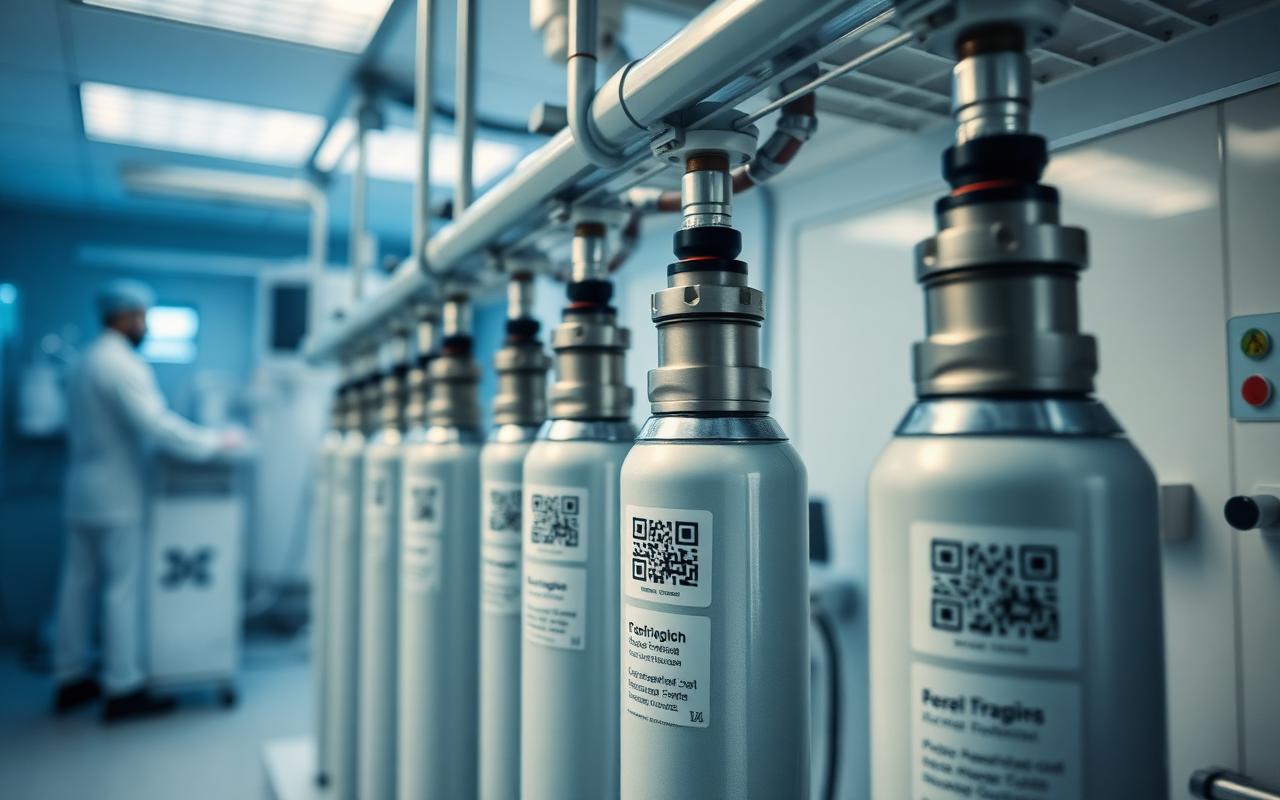
- Do you operate in a regulated sector like [Medical Gas](/industries/medical-gas) where end users outside your organisation need to verify a cylinder's status themselves? QR's ability to open a public digital passport without app installation is a strong fit, as covered in more depth in our oxygen cylinder traceability guide.
Implementing a hybrid approach: a practical rollout sequence
Most operations that end up using both technologies did not plan it that way from day one — they started with one, discovered its limits in a specific part of the operation, and layered in the second. You can shortcut that trial-and-error process with a more deliberate rollout.
- Audit your current scan points. List every place a cylinder gets identified today — filling, dispatch, delivery, customer receipt, return, testing — and note who performs the scan and what device they currently use, if any.
- Classify each scan point by accessibility need. Internal, controlled scan points with trained staff and existing scanner budgets are strong barcode candidates. Any scan point touched by customers, field staff, or outside parties is a strong QR candidate.
- Select label materials before code type. Regardless of which code you print, choose a rugged, chemical- and weather-resistant label material rated for the expected service life of the cylinder, since label failure from poor material choice will undermine either code type equally.
- Pilot on a limited batch. Apply new labels to a subset of cylinders and run them through a full cycle — fill, dispatch, delivery, return — before committing to a fleet-wide rollout, to catch any workflow friction early.
- Ensure your backend reads both formats. Choose or configure your tracking platform so a single scanning interface, whether a dedicated scanner or a mobile app, can read barcode, QR, and RFID interchangeably, so your team is not juggling different apps or devices depending on which cylinder they encounter.
- Train staff on fallback procedures. Even the most durable label eventually gets damaged beyond scanning; make sure every scan point has a documented manual override procedure that still captures the movement accurately rather than skipping the record entirely.
- Review scan failure rates regularly. Track how often staff report an unreadable code by location and label type, and use that data to decide where label material or code type needs upgrading.
The practical answer for most operations
For the majority of gas distribution businesses, the honest answer is that this is not an either-or decision. Barcodes remain excellent on high-speed, internally controlled filling and dispatch lines where dedicated scanner infrastructure already exists and performs well. QR codes extend that same tracking discipline into the field, to customers, and to any scenario where the person doing the scanning does not carry specialised equipment. A genuinely capable platform reads both formats interchangeably through the same interface, so the choice does not have to be made once and locked in forever — it can vary by scan point based on what that specific point in your operation actually needs.
Frequently asked questions
Can I switch from barcode to QR without relabelling my entire fleet? Most platforms support running both formats simultaneously during a transition period, allowing you to relabel cylinders gradually as they pass through routine inspection or hydro-testing cycles rather than requiring an immediate, disruptive fleet-wide relabelling exercise.
Which technology is cheaper overall? Label costs are broadly similar between the two. The larger cost difference lies in scanning hardware — barcode requires dedicated scanners for best performance, while QR leverages smartphones your team and customers likely already own, often reducing overall hardware spend for field and customer-facing scan points.
Do QR codes work if a customer has no internet connection? A QR code that simply encodes a serial number can be read offline, but one that links to a hosted digital passport page requires internet access to load that page. Well-designed systems cache key safety information so basic verification still works even with intermittent connectivity.
Is one technology more secure against counterfeiting than the other? Neither format alone prevents counterfeiting — a determined bad actor can reproduce either a barcode or a QR code. Genuine security comes from tying the code to a backend record that flags duplicate or unexpected scan patterns, which is a software capability rather than a property of the code format itself.
Should new operations start with barcode or QR? Operations expecting significant customer-facing or field scanning from day one, such as those in Healthcare or with a strong direct-to-customer delivery model, generally benefit from starting with QR given its zero-hardware-cost accessibility, while operations centred on high-speed internal filling and dispatch may find barcode's speed advantage more immediately valuable.
Making the decision with confidence
The right choice ultimately depends less on which technology is objectively "better" and more on matching the technology to where and by whom your cylinders actually get scanned. A platform that supports both barcode and QR — and layers in RFID where bulk scanning adds value — removes the pressure to get this decision perfectly right on day one, since you can adjust label strategy by location or cylinder category as your operation's needs become clearer over time.
To see how Cylinder Barcode Software and Cylinder QR Tracking work together within a single platform, book a demo with our team, or contact us to talk through which combination of identification technologies fits your specific fleet and customer base best.
Explore related GCT software
Put the ideas in this article into practice with the GCT modules and technologies built for it.
Run a smarter cylinder fleet with GCT
GCT gives gas companies barcode, QR & RFID tracking, automated billing, compliance dashboards and a mobile field app — all in one platform.
Running an enterprise gas distribution operation? Explore the Cylinder Tracking Management System at ctmsgas.com for enterprise-grade cylinder ERP deployments.