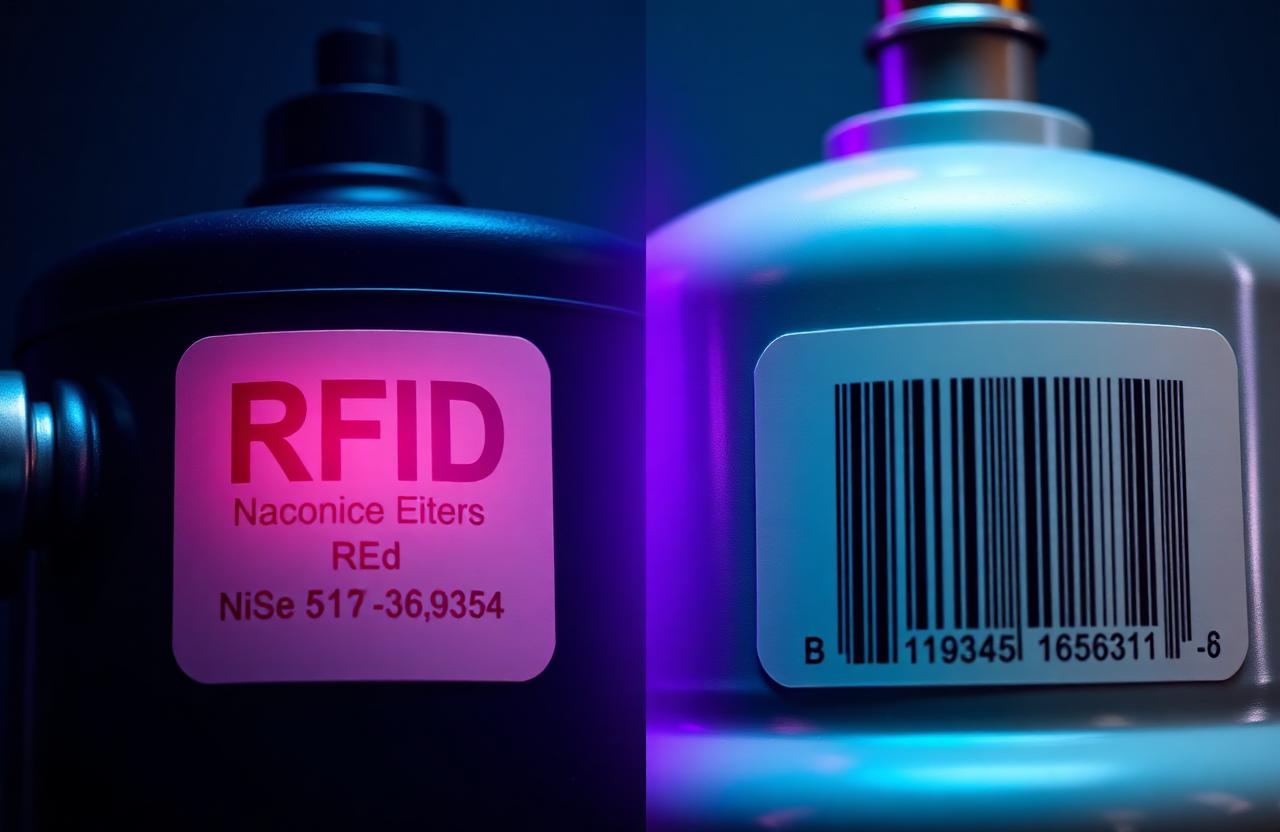
RFID vs Barcode for Cylinder Tracking: Which Should You Choose?
Choosing between RFID and barcode identification is one of the first — and most consequential — decisions a gas company faces when digitising its cylinder fleet. Get it right and scanning becomes an invisible part of daily operations; get it wrong and staff quietly abandon the system within months because it slows them down. The good news is that both technologies work well in the right context, and the decision usually comes down to three practical factors: how many cylinders move past a single point per hour, how harsh your operating environment is, and what you can spend per cylinder.
This article walks through the real differences between the two approaches, where each wins, and why the fleets that get the most value from digital tracking usually end up using both rather than picking one and discarding the other.
The core technical difference
Barcodes and QR codes are optical and line-of-sight: a scanner or camera has to physically see the label, unobstructed, to read it — one cylinder at a time. RFID is radio-based: a reader emits a signal that a small chip embedded in or attached to the cylinder responds to, and a single reader can capture dozens of tags simultaneously, even when the tags are not directly visible, as cylinders pass through a gate or sit stacked in a pallet.
That single distinction — one-at-a-time versus many-at-once — is the root of almost every practical tradeoff between the two technologies. Everything else, from cost to durability to read range, flows from that underlying design difference.
How each technology actually works in the field
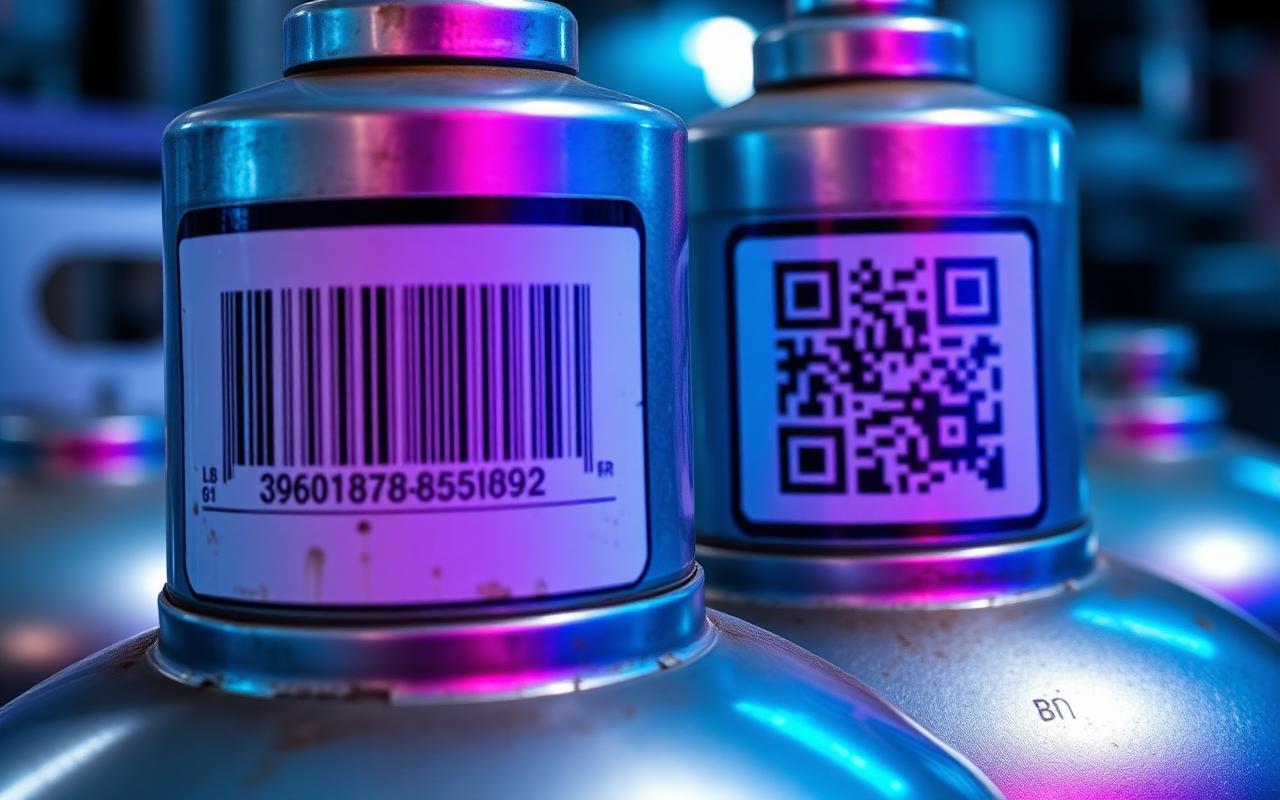
A barcode or QR code label is printed with a unique pattern that encodes a cylinder's serial number. A handheld scanner or a smartphone camera reads that pattern and looks up the corresponding record in the tracking database. The scan takes a fraction of a second, but the operator has to physically point the scanner at each label in turn, which means throughput is naturally capped by human speed.
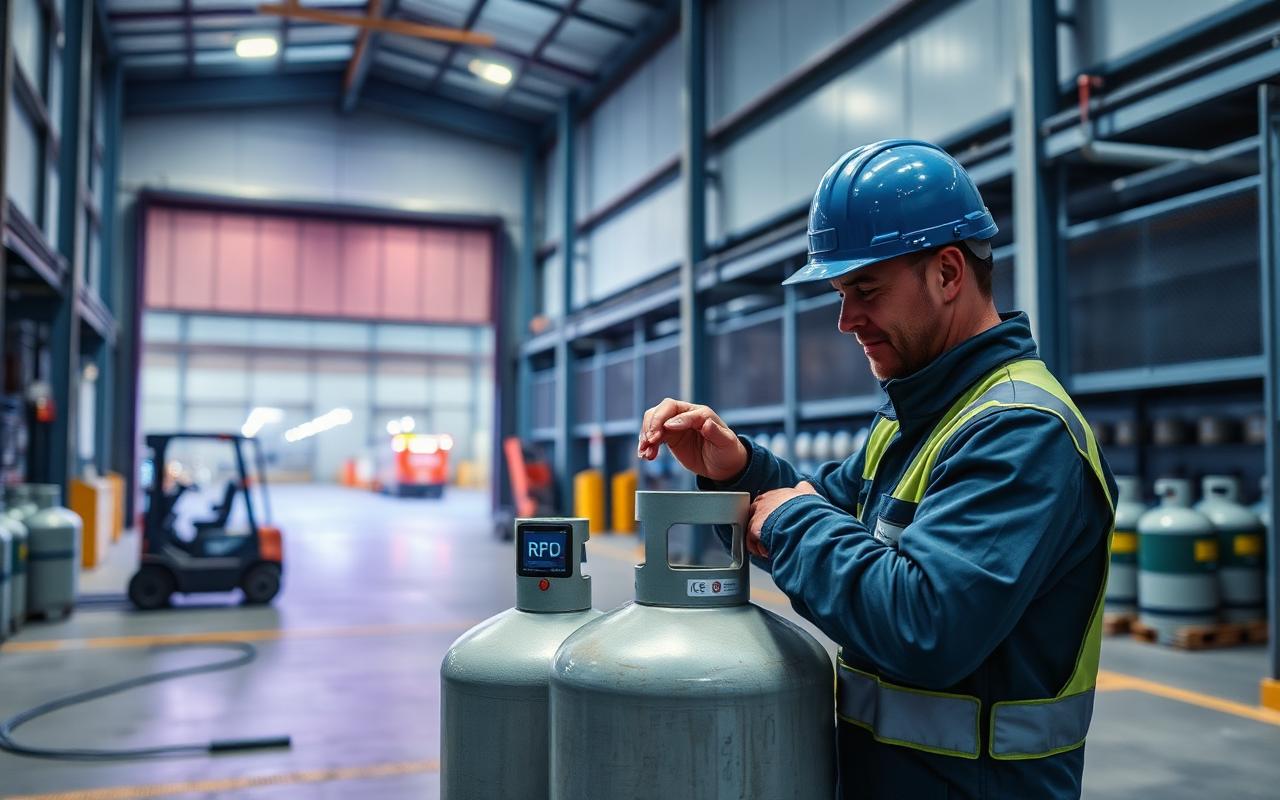
RFID tags, by contrast, are small chips — often embedded in a rugged plastic housing or tag — that store a unique identifier and broadcast it when energised by a nearby reader's radio signal. Fixed readers mounted at a plant gate, loading dock or dispatch bay can detect every tagged cylinder passing through in a matter of seconds, without any human needing to point anything at anything.
Head-to-head comparison
| Factor | Barcode / QR | RFID |
|---|---|---|
| --- | --- | --- |
| Read method | One at a time, requires line of sight | Bulk reads, no line of sight required |
| Speed at a gate or dock | Slow — limited by manual scanning | Very fast — dozens of tags per second |
| Cost per cylinder | Low (label + printing) | Higher (chip + tag housing) |
| Durability in harsh environments | Good, with the right industrial label stock | Excellent — tags can be embedded or ruggedised |
| Reader hardware cost | Cheap and widely available (including smartphones) | More expensive, needs fixed or handheld RFID readers |
| Best environment | Indoor counters, filling stations, workshops | Yards, gates, high-volume loading and dispatch points |
| Customer-facing use | Excellent — anyone can scan a QR with a phone | Poor — customers don't carry RFID readers |
| Integration effort | Minimal, plug-and-play with most smartphones | Requires reader installation and network setup |
When barcode or QR code wins
Barcode and QR code identification tends to be the right first choice for a wide range of gas businesses, particularly when:
- You are cost-sensitive and need to tag a large existing fleet quickly without a major upfront hardware investment.
- Most scanning happens indoors, at a counter, filling station or workshop bench, where line-of-sight scanning is not a bottleneck.
- You want a customer-facing digital passport — a QR code that any customer, dealer or auditor can scan with an ordinary smartphone to see a cylinder's specifications, test history and compliance status without needing any special app or hardware, delivered through a customer portal.
- Your current process is entirely paper-based, and simply moving to any digital scanning — even one cylinder at a time — represents a massive leap forward.
Because barcode and QR labels are inexpensive to print and apply, they are also the natural starting point for a phased rollout, since you can tag your entire existing fleet without a large capital outlay before deciding where RFID adds enough value to justify the extra cost.
When RFID wins
RFID becomes the clearly superior choice once volume or environment push past what manual scanning can handle:
- Cylinders move through gates or loading bays in bulk, and you need an instant count rather than a queue of drivers waiting to have each cylinder scanned individually.
- Manual scanning has become a visible bottleneck at dispatch and returns — trucks queuing at the gate while staff scan cylinders one by one is a clear sign RFID would pay for itself quickly.
- The operating environment is harsh: oily, dusty, high-heat, or subject to rough handling that damages printed labels faster than they can be reapplied.
- You need to reconcile large truckloads or pallet quantities of cylinders quickly during stock counts, rather than scanning each one individually during a physical audit.
The most common mistake gas companies make is treating this as a binary either/or decision made once, upfront, for the entire fleet. In practice, high-performing fleets combine both technologies deliberately, matching each to the part of the operation where it delivers the most value.
Cost considerations beyond the tag itself
It's easy to compare RFID and barcode purely on a per-tag cost basis, but the full cost picture includes several other factors worth weighing:
- Reader hardware. A single RFID reader installed at a plant gate can replace the need for multiple staff members manually scanning barcodes during peak dispatch hours, which can offset the higher per-tag cost surprisingly quickly at high-volume sites.
- Labour time saved. If gate throughput currently limits how many trucks you can load or unload per hour, RFID's speed advantage can directly increase daily dispatch capacity without adding staff.
- Tag replacement frequency. In harsh environments, barcode labels may need reprinting and reapplication more often than a ruggedised RFID tag, so the "low cost" of barcode labels can be eroded by ongoing replacement costs over a cylinder's multi-decade life.
- Software licensing. Most tracking platforms, including GCT, price per cylinder or per module rather than per technology, so the underlying software cost is usually identical regardless of which identification method you choose — the difference is purely in tags and readers.
The hybrid approach in practice
A blended model is the pattern we see most often among mature operators. It typically looks like this: every cylinder in the fleet carries a low-cost barcode or QR label for everyday, item-level scanning at filling stations, workshops and customer counters. In parallel, high-throughput choke points — usually plant entry and exit gates, large dispatch bays, or bulk storage yards — are equipped with RFID readers, and the same cylinders additionally carry a small RFID tag that gets read automatically as they pass through those points.
This means a single cylinder might be scanned via barcode when it's filled at a station, then automatically counted via RFID as the truck carrying it exits the plant gate, with both events landing in the same digital record without any duplicate data entry. A platform that natively supports both identification methods within the same database — as GCT does — lets you start with barcode across the whole fleet and layer RFID onto your busiest sites later, without re-tagging existing cylinders or migrating to a different platform.
Implementation: how to actually decide and roll out
- Map your throughput points. For every location where cylinders change hands or cross a boundary — filling stations, gates, dispatch bays, customer counters — record roughly how many cylinders move through it per hour at peak.
- Identify your bottlenecks. Any point where that hourly volume already causes queuing or delays with a manual process is a strong RFID candidate; everywhere else, barcode is likely sufficient.
- Calculate environment risk. For each location, assess how quickly a printed label would degrade — is it exposed to oil, extreme heat, outdoor weather, or rough handling? Higher risk locations favour RFID or ruggedised barcode labels.
- Start with barcode fleet-wide. Tag your entire existing stock with barcode or QR labels first, since this gives you full visibility at minimal cost and establishes the digital record for every cylinder.
- Add RFID at your top two or three bottleneck points. Install readers only where the throughput data justifies it, and measure the before-and-after impact on gate or dispatch times.
- Review after 90 days. Use real operational data — not assumptions — to decide whether additional locations warrant RFID investment.
A note on QR codes and the customer experience
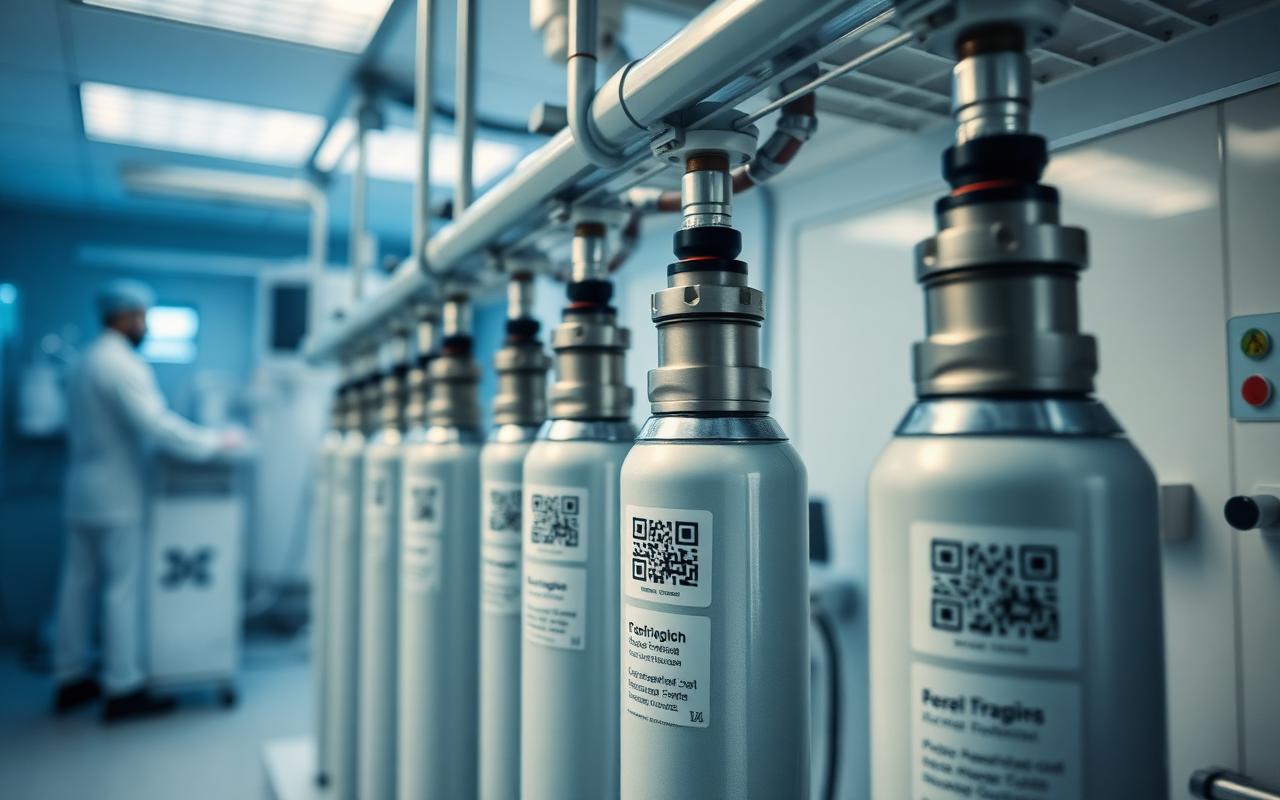
It's worth separating QR codes from barcodes for a moment, even though they share the "line-of-sight, one-at-a-time" limitation, because QR codes serve a distinct purpose beyond internal scanning. A QR code printed on a cylinder can act as a public-facing digital passport: any customer, auditor or field technician with a smartphone can scan it and instantly see the cylinder's gas type, fill date, hydro-test due date, and compliance status, without needing an account or special app. This is particularly valuable in regulated sectors like medical gas, where hospital staff need to verify cylinder compliance quickly, and in industrial gas settings where safety officers routinely audit cylinders on customer premises.
Making the final decision for your fleet
Ask yourself three questions, and the right mix usually becomes obvious:
- How many cylinders pass a single point per hour at your busiest location?
- How harsh is the environment cylinders operate in — indoor and controlled, or outdoor, oily and high-turnover?
- What is your realistic budget per cylinder, and does that budget need to cover the entire fleet at once, or can it be phased?
Map the answers against the comparison table above, and you will typically find that barcode or QR covers 80-90% of your fleet's everyday scanning needs, with RFID reserved for a small number of high-value locations where speed genuinely matters.
Industry-specific patterns worth knowing
Different segments of the gas industry tend to gravitate toward different mixes, shaped by how their cylinders actually move. In LPG distribution, where trucks deliver and collect large numbers of cylinders per stop and turnaround speed at the depot directly affects how many routes a fleet can run per day, RFID at depot gates is often one of the highest-ROI single investments a company can make, because it removes the single biggest daily bottleneck. In cryogenic and specialty gas operations, where individual cylinders are high-value and low-volume, barcode or QR tracking is often entirely sufficient, since the throughput never reaches a point where bulk RFID reads meaningfully outperform careful, individual scanning. Healthcare and medical gas environments frequently favour QR codes specifically because hospital staff, auditors and safety inspectors need to verify individual cylinders on the spot using devices they already carry, rather than specialised RFID readers that would need to be installed throughout a hospital campus.
Understanding which pattern matches your own operation is often more useful than reading generic technology comparisons, because the "right" answer genuinely differs between a bulk LPG distributor cycling thousands of cylinders daily and a specialty gas supplier managing a few hundred high-value cryogenic vessels.
Underlying software matters more than the tag
It's worth emphasising a point that often gets lost in RFID-versus-barcode debates: the identification technology is only the capture mechanism. The real value comes from what happens to that data afterward — whether it flows into a proper cylinder inventory software system that reconciles stock automatically, feeds a cylinder ERP for billing and deposits, or simply sits in a spreadsheet that nobody reviews. A company with perfect RFID coverage but no downstream analytics or alerting gets very little more value than one running plain barcodes, because the bottleneck has simply moved from data capture to data usage. Before investing heavily in either identification technology, it is worth confirming that the software behind it can actually turn the scan events into dashboards, alerts and automated billing — otherwise you are paying a premium for data collection with nowhere useful for that data to go.
Planning for the next decade, not just the next quarter
Cylinders often stay in service for twenty to forty years, which means whatever identification approach you choose today needs to keep working long after the initial rollout team has moved on. This is one more reason phased, hybrid adoption tends to outperform an all-or-nothing bet: a barcode-first fleet can add RFID at new plants as they open, without ever needing to retrofit tags across the entire installed base at once. Similarly, as IoT sensors and condition-monitoring hardware become more common on cylinders, the identification layer you choose now becomes the backbone that those future capabilities attach to, so it is worth choosing a platform built to absorb new hardware and sensor types rather than one locked permanently to a single scanning method or vendor.
Frequently asked questions
Can a single cylinder carry both a barcode and an RFID tag? Yes, and this is exactly what the hybrid approach recommends — both are simply pointers to the same underlying digital record, so there's no conflict in having both on one cylinder.
Is RFID reliable around pressurised gas cylinders, or is there a safety concern? Passive RFID tags used in cylinder tracking are low-power and intrinsically safe; they do not pose an ignition or interference risk and are widely used in industrial gas environments including oxygen and flammable gas fleets.
How much does an RFID tag typically cost compared to a barcode label? RFID tags are generally several times more expensive per unit than a printed barcode label, though the gap has narrowed considerably as adoption has grown across industrial sectors.
Do we need new smartphones or scanners for barcode scanning, or can we use what we already have? Most modern smartphones can scan barcodes and QR codes natively through a camera, meaning many companies start barcode-based tracking with devices staff already carry via a driver mobile app, before investing in dedicated handheld scanners.
If we start with barcode only, is it hard to add RFID later? Not on a platform designed for both from the outset — cylinders simply get an additional RFID tag applied during a routine touchpoint, and the system links it to the existing digital record without disrupting historical data.
The bottom line
RFID and barcode are not competing standards so much as complementary tools solving different problems — one optimised for cost and ubiquity, the other for speed and bulk throughput. The fleets that get the most value treat the choice as an ongoing engineering decision made location by location, not a single company-wide bet made once and never revisited.
Want help modelling which mix makes sense for your specific plant layout and throughput? Talk to a specialist who works with industrial and medical gas fleets daily, or book a demo to see both barcode and RFID workflows running side by side inside GCT.
Explore related GCT software
Put the ideas in this article into practice with the GCT modules and technologies built for it.
Run a smarter cylinder fleet with GCT
GCT gives gas companies barcode, QR & RFID tracking, automated billing, compliance dashboards and a mobile field app — all in one platform.
Running an enterprise gas distribution operation? Explore the Cylinder Tracking Management System at ctmsgas.com for enterprise-grade cylinder ERP deployments.