RFID
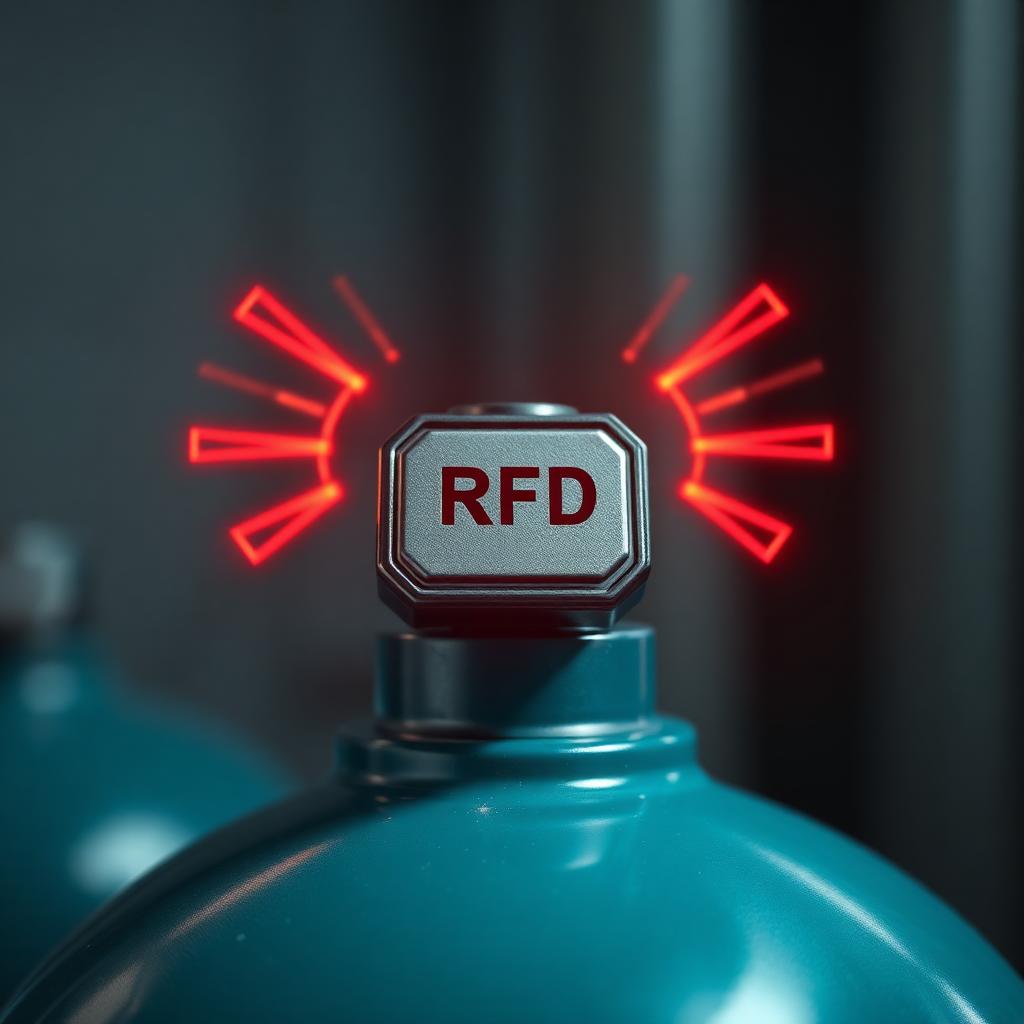
RFID (Radio-Frequency Identification) lets cylinders identify themselves wirelessly — a small tag on each cylinder responds to a reader's radio signal, no line-of-sight or manual scan required.
In cylinder operations, RFID's superpower is bulk reading: a gate reader can capture dozens of cylinders as a truck drives through, making it the technology of choice for high-throughput dispatch and receipt.
Understanding RFID's strengths — and its higher tag cost versus barcode — helps gas businesses apply it exactly where speed and volume justify the investment.

Key benefits
Bulk, hands-free reads
Many cylinders are read at once with no line-of-sight, unlike barcode or QR.
Speed at the gate
Ideal for high-volume dispatch and receipt where scanning each cylinder is too slow.
Rugged and durable
Industrial RFID tags withstand harsh handling and outdoor storage.
Automation-ready
Reads can trigger workflows automatically, reducing manual steps.
What's included
- Passive RFID tags on each cylinder
- Fixed gate readers for bulk capture
- Handheld readers for spot checks
- No line-of-sight requirement
- Automatic dispatch/receipt triggers
- Works alongside barcode and QR in GCT
Frequently asked questions
How does RFID identify a cylinder?
Each cylinder carries an RFID tag that responds to a reader's radio signal with a unique ID — no scanning or line-of-sight is needed.
Where is RFID most useful?
At high-volume gates and dispatch bays, where reading dozens of cylinders in one pass saves significant time over barcode.
Is RFID more expensive than barcode?
Tags cost more than barcode labels, so RFID is best applied where its bulk-read speed justifies the cost.
Can RFID work with barcode and QR?
Yes. GCT supports all three together, letting you use RFID at busy gates and barcode/QR elsewhere.
Ready to gain full control of every cylinder?
Book a personalized GCT demo and see how leading gas companies eliminate cylinder losses.