
RFID Cylinder Tracking: A Step-by-Step Implementation Guide
RFID is the technology that finally makes bulk, hands-free cylinder reads practical — a truck rolls through a gate and every cylinder on board is logged in seconds, with no one aiming a scanner at a single barcode. That capability is genuinely transformative for high-volume operations. But RFID projects that fail almost always fail for the same reasons: the wrong tags, badly placed readers, or a data workflow nobody designed before go-live. This is a practical, step-by-step implementation guide built around the mistakes we see most often, so you can avoid repeating them.
Why RFID is different from barcode or QR projects
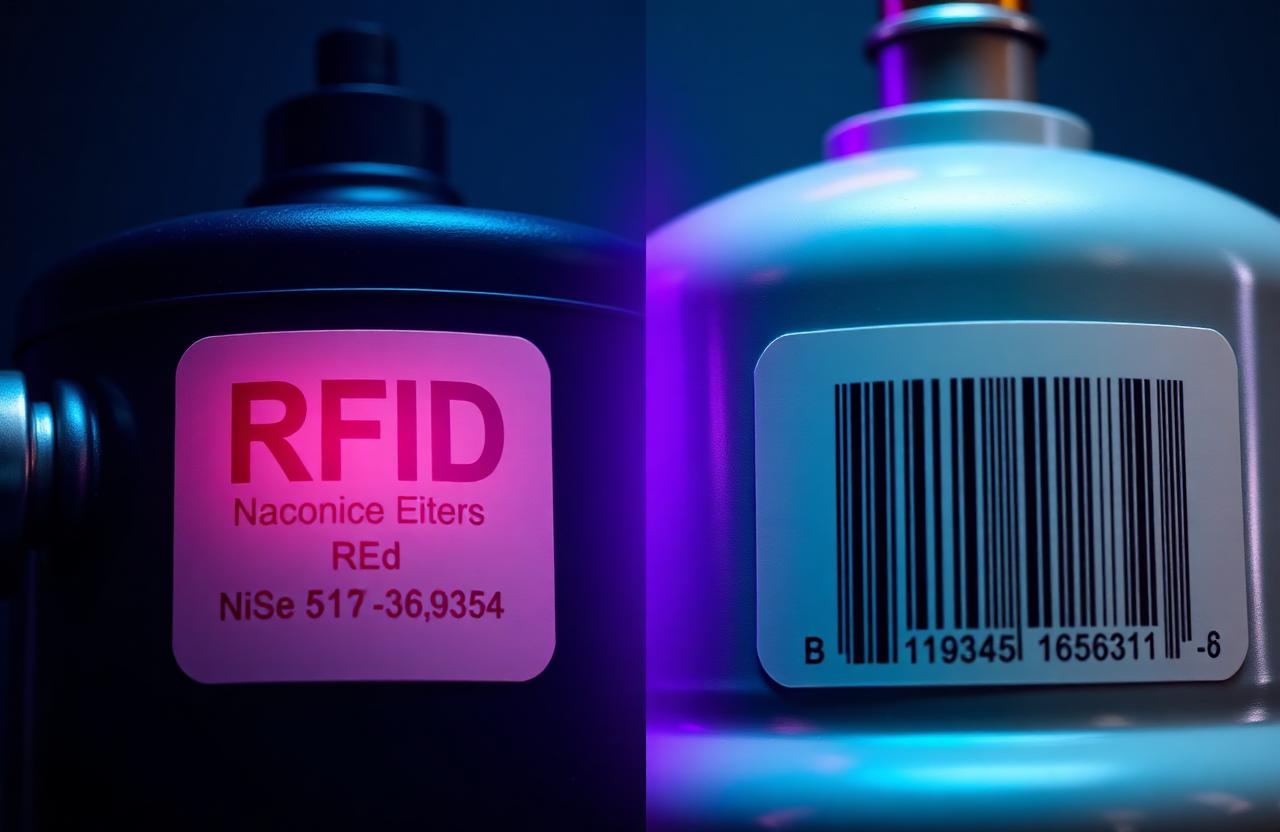
Barcode and QR code tracking are line-of-sight technologies — a person or a fixed scanner has to see the code to read it, which makes the workflow intuitive but limits throughput. RFID removes the line-of-sight requirement entirely, using radio waves to read tags in bulk, at a distance, without anyone touching a scanner. That is exactly what makes it so valuable at high-throughput choke points like plant gates, dock doors and truck loading bays — and exactly why getting the physical implementation wrong causes so much frustration. A misconfigured RFID gate either misses cylinders it should catch, or catches cylinders that were never meant to be counted, and both failure modes erode trust in the system fast.
Step 1: choose the right tag for the physical reality of a cylinder
Industrial gas cylinders are one of the harshest environments a passive RFID tag will ever face: bare or painted steel bodies, high-pressure handling, repeated impacts during loading, exposure to heat, moisture, solvents and, in some industries, cryogenic temperatures. A few tag selection principles matter more than any brand name:
- Use metal-mount UHF tags, not standard adhesive tags. Standard RFID tags detune badly or fail entirely when mounted directly on steel; metal-mount tags are engineered with a spacer layer specifically to counter this effect.
- Match read range to your gate width, not a generic spec sheet number. A tag rated for a six-metre read range in open air may perform very differently mounted on a densely packed steel cylinder pallet — always test in your actual physical layout.
- Choose an IP-rated, impact-resistant tag housing. Cylinders get dropped, dragged and stacked; a tag housing rated for outdoor industrial use will survive years of handling where a lightweight consumer-grade tag will crack or delaminate within months.
- Standardise mounting position across the fleet. If tags are mounted inconsistently — some on the shoulder, some on the body, some near the valve — read reliability becomes unpredictable simply due to antenna orientation differences.
- Plan for tag replacement, not just tag installation. Even rugged tags have a failure rate over a multi-year cylinder lifespan; build a periodic audit into your maintenance schedule rather than assuming a tag applied once will last the cylinder's entire life.
Step 2: plan reader placement around actual ownership and location changes
The single most common RFID implementation mistake is treating reader placement as an afterthought — bolting readers wherever is physically convenient rather than wherever a meaningful business event actually occurs. Before ordering hardware, map every point in your operation where a cylinder's location or ownership status changes:
- Plant gate (cylinders leaving for dispatch, cylinders returning empty)
- Filling station entry and exit
- Test bay entry and exit
- Dock doors for truck loading and unloading
- Yard storage zone boundaries, if zone-level location matters for your reporting
- Customer site delivery point, typically covered by handheld or vehicle-mounted readers rather than fixed infrastructure
Fixed readers belong at high-traffic, high-value choke points — plant gates and dock doors — where automatic, continuous capture justifies the infrastructure cost. Handheld readers are the right tool for yard audits, cycle counts and exception handling, where flexibility matters more than automation. Vehicle-mounted readers bridge the gap for delivery routes, capturing reads as a truck approaches a customer site without requiring a driver to manually scan each cylinder — a natural complement to the Driver Mobile App used for proof-of-delivery capture.
Step 3: design the data workflow before you design the network
This is the step most implementation teams skip, and it is the one that causes the most operational pain afterward. A raw RFID read is just a signal: "tag X was detected by reader Y at time Z." It has no inherent business meaning until you define the rules that translate it into a ledger event. Before go-live, explicitly decide:
- What does a gate-out read mean? Typically it should trigger a dispatch record, but only if it is correlated with an actual outbound truck movement — otherwise a cylinder rolled near the gate during yard reshuffling could falsely register as dispatched.
- What does a gate-in read mean? Usually a return event, closing out a prior dispatch record and updating cylinder status to available or pending inspection.
- How do you handle a duplicate read? A cylinder detected twice within a short window — because it passed the gate antenna's field twice, or because two overlapping antennas both picked it up — needs a deduplication rule, typically a minimum time threshold between counted events for the same tag.
- How do you handle a "phantom" read? A tag detected at a gate reader because it happened to be on a pallet passing nearby, without actually leaving the site, needs an exception workflow rather than silently corrupting the ledger.
- Who reviews exceptions, and how often? Define a specific role — often a warehouse supervisor — responsible for reviewing and resolving ambiguous reads daily, not letting them accumulate into an unreconciled backlog.
Getting this logic right is what separates a system that produces a trustworthy ledger from one that produces a flood of raw data nobody trusts enough to act on. This workflow design work is exactly what a purpose-built Cylinder RFID Software platform handles out of the box, rather than requiring your team to build reconciliation logic from scratch.
Step 4: pilot before you scale
Never deploy RFID fleet-wide in one step. Instead:
- Select a single plant or gate as the pilot site. Choose one with representative traffic patterns and cylinder mix, not your quietest or simplest location.
- Tag a meaningful subset of the fleet. A few hundred cylinders is usually enough to expose real-world read issues without a large upfront hardware spend.
- Tune antenna power and angle iteratively. Expect several rounds of adjustment; RFID read performance is highly sensitive to antenna orientation, nearby metal structures and even weather in outdoor installations.
- Measure read accuracy against a manual count over at least a week. Compare RFID-reported dispatch and return counts against a physical audit to quantify the miss rate and false-positive rate before trusting the system for financial reconciliation.
- Refine the exception workflow based on real pilot data. The rules you designed on paper in step three will need adjustment once you see actual edge cases from live traffic.
- Only then plan the fleet-wide rollout, using the pilot's read-accuracy benchmarks as your acceptance criteria for each subsequent site.
Common mistakes and how to avoid them
| Mistake | Why it happens | How to avoid it |
|---|---|---|
| --- | --- | --- |
| Using non-metal-mount tags on steel cylinders | Cheaper tags look identical on a spec sheet | Always specify metal-mount UHF tags for steel cylinder bodies |
| Over-powering readers | Assumption that more power means better reads | Tune power to your actual gate width; excess power captures unintended tags |
| Skipping data-workflow design | Focus goes entirely to hardware procurement | Design ledger rules before ordering readers, not after |
| No pilot phase | Pressure to show fleet-wide results quickly | Insist on a contained pilot with measurable accuracy benchmarks |
| Inconsistent tag mounting position | No documented mounting standard | Publish and enforce a single mounting standard across install teams |
| Ignoring reader interference from nearby metal racking | Physical site layout not surveyed before installation | Conduct an on-site RF survey before finalising reader positions |
| Treating RFID as a total barcode replacement | Assumption that newer technology should replace older | Evaluate cost-per-cylinder tradeoffs; barcode often remains appropriate for lower-turnover assets |
RFID or barcode — or both?
A frequent misconception is that RFID is simply a superior replacement for barcode or QR identification, and that a mature operation should migrate everything to RFID. In practice, the two technologies solve different problems and many mature operations run both side by side: barcode or QR for low-cost, unambiguous per-cylinder identity at the filling station and during manual inspection, and RFID specifically for bulk, hands-free reads at high-traffic chokepoints where line-of-sight scanning would be too slow. Choosing the right technology per touchpoint, rather than standardising on one everywhere, is usually the more cost-effective path. For a detailed breakdown of the tradeoffs, see RFID vs barcode and explore the parallel Cylinder Barcode Software and Cylinder QR Tracking options to see where each fits your fleet.
Budgeting for an RFID rollout
RFID hardware costs more upfront than barcode labels, and that difference needs to be part of your business case from the start. Typical cost components include:
- Per-tag cost, which varies significantly based on ruggedness and read-range requirements
- Fixed reader and antenna infrastructure, installed at each gate or dock door
- Handheld reader devices for yard audits and mobile use cases
- Site survey and installation labour, particularly for RF interference mitigation
- Software licensing for the platform ingesting and interpreting reads, typically bundled within a broader gas cylinder tracking platform
- Ongoing tag replacement as a recurring, budgeted cost rather than a surprise expense
Weigh these costs against the throughput gains at your highest-volume chokepoints specifically — RFID's return on investment is strongest exactly where manual scanning would otherwise create a bottleneck, such as high-volume cylinder dispatch operations, and weaker at low-volume touchpoints where a barcode scan takes no meaningful extra time.
Integrating RFID data into the broader logistics picture
RFID reads are most valuable when they feed directly into your broader operational systems rather than sitting in an isolated reporting dashboard. Dispatch reads should automatically trigger delivery scheduling and driver assignment within your cylinder logistics workflow; return reads should automatically update available inventory counts for the cylinder inventory view used by planners; and test-bay reads should feed the compliance calendar so cylinder testing schedules stay accurate without manual data entry. Treating RFID purely as an access-control or security technology, disconnected from these downstream workflows, leaves most of its value on the table.
Planning the RF site survey properly
Before any hardware is purchased, a proper RF site survey should be conducted at every candidate reader location. Industrial sites are full of the kind of large metal structures — racking, containers, other cylinders, structural steel — that reflect and absorb radio waves unpredictably, and a survey conducted with a temporary reader and a handful of sample tags will reveal issues that no spec sheet can predict. Walk the actual gate or dock door with tagged cylinders at different distances, angles and stacking configurations, and record signal strength and read consistency at each position. Pay particular attention to areas where multiple readers' fields might overlap, since overlapping antenna fields are a common source of the duplicate-read problem described earlier. Document the survey results and use them to finalise both the antenna count and mounting height for each location, rather than relying on a generic vendor recommendation that was not tested against your specific site conditions.
Training staff to work with, not around, an RFID system
Even a technically flawless RFID deployment can fail if the people working around it are not trained to understand how it behaves. Warehouse and yard staff need to understand, for example, that walking a tagged cylinder past a gate reader without actually loading it onto a truck can still register a false read if they linger too close to the antenna field, and that leaving cylinders stacked near a gate for staging purposes may trigger unintended reads. Rather than treating this as a purely technical problem to engineer around, effective deployments also invest in a short, practical training session for gate and dock staff explaining where the read zones are and what behaviours to avoid. This is a low-cost step that meaningfully reduces the volume of exception reads the system generates, which in turn reduces the burden on whoever is responsible for reviewing them daily.
Scaling from one site to a multi-site RFID network
Once a pilot site has proven out tag selection, reader placement and workflow logic, scaling to additional sites is rarely a simple copy-paste exercise. Each site has its own physical layout, traffic patterns and construction materials, which means the RF survey step needs to be repeated at every new location rather than assumed to generalise from the pilot. That said, several elements from the pilot do transfer directly and should be standardized across all sites to avoid re-solving the same problems repeatedly: the tag specification and mounting standard, the exception-handling workflow and escalation ownership, and the reporting structure that feeds dispatch and compliance data into central systems. Maintaining a central RFID rollout playbook — documenting site survey templates, standard antenna configurations for common gate widths, and the lessons learned from earlier sites — significantly reduces the time and cost of each subsequent site's deployment compared to treating every location as a fresh project.
Maintenance and ongoing performance monitoring
An RFID deployment is not a one-time install-and-forget project. Reader antennas can drift out of optimal alignment due to vibration or accidental impact, tags degrade or fail at a low but nonzero rate over years of handling, and read accuracy should be periodically re-validated against manual counts rather than assumed to remain constant indefinitely. Building a quarterly or semi-annual audit into the maintenance schedule — comparing system-reported dispatch and return counts against a physical spot count at each major gate — catches performance drift before it accumulates into a meaningful reconciliation problem. Many operators also track a simple read-accuracy metric per gate over time, which both flags hardware issues early and provides useful evidence for internal stakeholders that the system remains reliable as the fleet and traffic patterns evolve.
Frequently asked questions
How long does a typical RFID pilot take before we can judge results? Most operations need at least one to two weeks of live gate traffic to gather enough read data to meaningfully compare against a manual audit, though antenna tuning often continues iteratively for several weeks beyond that.
Can RFID tags be retrofitted onto our existing cylinder fleet? Yes, in most cases. Metal-mount UHF tags can be applied to existing cylinders during a routine handling point such as a test cycle or a scheduled yard audit, avoiding the need for a dedicated fleet-wide tagging shutdown.
What is the typical lifespan of an industrial RFID tag on a cylinder? With a properly rated rugged tag, several years of service life is typical, though this varies with handling intensity and environmental exposure — periodic audits are still recommended to catch failed tags before they create reporting gaps.
Do we need new gate infrastructure, or can existing gates be retrofitted with readers? Most plant gates and dock doors can be retrofitted with fixed RFID antennas without structural changes, though an on-site RF survey is essential to confirm placement and rule out interference from nearby metal structures.
Is RFID overkill for a smaller cylinder fleet? For fleets with low daily throughput at each site, the fixed infrastructure cost of RFID may not be justified compared to barcode or QR scanning; RFID's advantage grows specifically with gate traffic volume, so smaller operations often start with barcode and revisit RFID as volume grows.
A well-implemented RFID deployment turns your busiest chokepoints from manual bottlenecks into automatic, reliable data sources — but only if the tag selection, reader placement and data workflow are designed deliberately rather than assembled ad hoc. If you are planning an RFID rollout, book a demo to see how the workflow design and exception handling work in a live system, or contact us to discuss a site survey for your specific gate and plant layout.
Explore related GCT software
Put the ideas in this article into practice with the GCT modules and technologies built for it.
Run a smarter cylinder fleet with GCT
GCT gives gas companies barcode, QR & RFID tracking, automated billing, compliance dashboards and a mobile field app — all in one platform.
Running an enterprise gas distribution operation? Explore the Cylinder Tracking Management System at ctmsgas.com for enterprise-grade cylinder ERP deployments.