
AI & Predictive Maintenance for Gas Cylinders
Every cylinder that moves through a modern gas distribution network leaves behind a trail of data: a scan at filling, a scan at dispatch, a scan at the customer site, a scan at return, plus sensor readings if the cylinder is instrumented. For decades that data trail was thrown away the moment a transaction closed. Today it is the raw material for one of the most valuable shifts in industrial gas operations — predictive maintenance powered by artificial intelligence. Instead of waiting for a cylinder to fail an inspection, leak, or simply vanish from the fleet, operators can now use historical patterns to see problems coming and act before they cost money or create safety risk.
This article is a practical look at how AI-based predictive maintenance actually works for gas cylinder fleets, what data it needs, what it can and cannot do today, and how to introduce it into an operation without needing a data-science department.
Why calendar-based maintenance falls short
Most cylinder testing and maintenance programs are still built around fixed calendar intervals — hydro test every five years, valve inspection every service cycle, visual check at every fill. Calendar-based scheduling is simple to explain and easy to audit, which is why it has survived so long. But it treats every cylinder as if it experiences identical wear, which is rarely true.
A cylinder used mostly in a controlled hospital environment for medical gas delivery experiences very different stress than one cycling daily through an industrial gas plant, exposed to temperature swings, rough handling and corrosive atmospheres. Under a pure calendar system, the hospital cylinder may be tested more often than it needs, wasting money and cylinder downtime, while the industrial cylinder may go the full interval even though real-world wear suggests it deserves an earlier look. Calendar maintenance is, in effect, an average applied to a population that does not behave like an average.
What "predictive" actually means in this context
Predictive maintenance does not mean guessing. It means using a cylinder's own history — how often it moves, how far it travels, what pressures it has been filled to, how many times it has been dropped or flagged for damage, how long it sits idle, and (where available) live telemetry from IoT-enabled valves or smart caps — to estimate the probability that it needs attention sooner than its calendar date, or that it can safely wait longer without any compromise on compliance.
The output isn't a black-box verdict handed down with no explanation. In a well-designed system it is a ranked list: these 40 cylinders are trending toward a compliance gap in the next 60 days based on usage intensity; these 15 have movement patterns consistent with cylinders that historically get lost or go unreturned; these 8 show anomaly signatures — unusual pressure drop rates or dwell times — that warrant a physical inspection ahead of schedule.
The four things AI can reliably predict today
- Upcoming test and inspection needs, prioritised by risk. Rather than a flat list sorted by due date, the model ranks cylinders by a combination of due date proximity and usage intensity, so your test bay tackles the highest-risk assets first.
- Cylinders likely to be lost or go unreturned. Movement pattern analysis — long dwell times at a customer site, irregular return cycles, comparison against similar customer accounts — flags cylinders worth a proactive follow-up call before they become a write-off.
- Optimal fleet sizing. By modelling seasonal demand against turnaround time, AI can tell you whether you are overinvesting in idle cylinders or under-provisioned for peak season, informing procurement decisions months in advance.
- Demand peaks by region or product. Historical order patterns combined with external signals (season, local industrial activity, weather for LPG demand) let you pre-position stock at the depot level instead of reacting after a stockout.
Why the data foundation matters more than the algorithm
It is tempting to think the value is in the AI model itself. In practice, the value is overwhelmingly in the quality and consistency of the data feeding it. A model trained on sparse, inconsistent scan data — where cylinders are only recorded at some checkpoints and not others — will produce unreliable predictions no matter how sophisticated the underlying algorithm is.
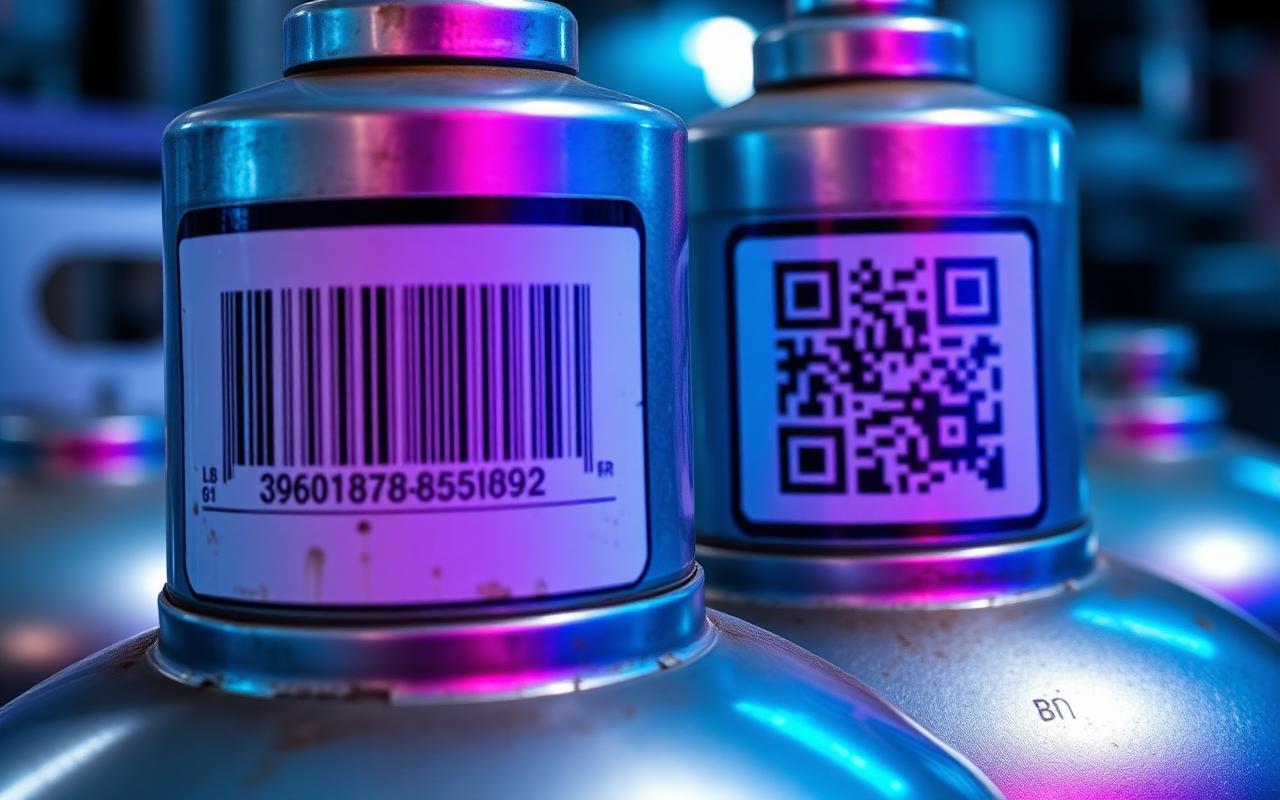
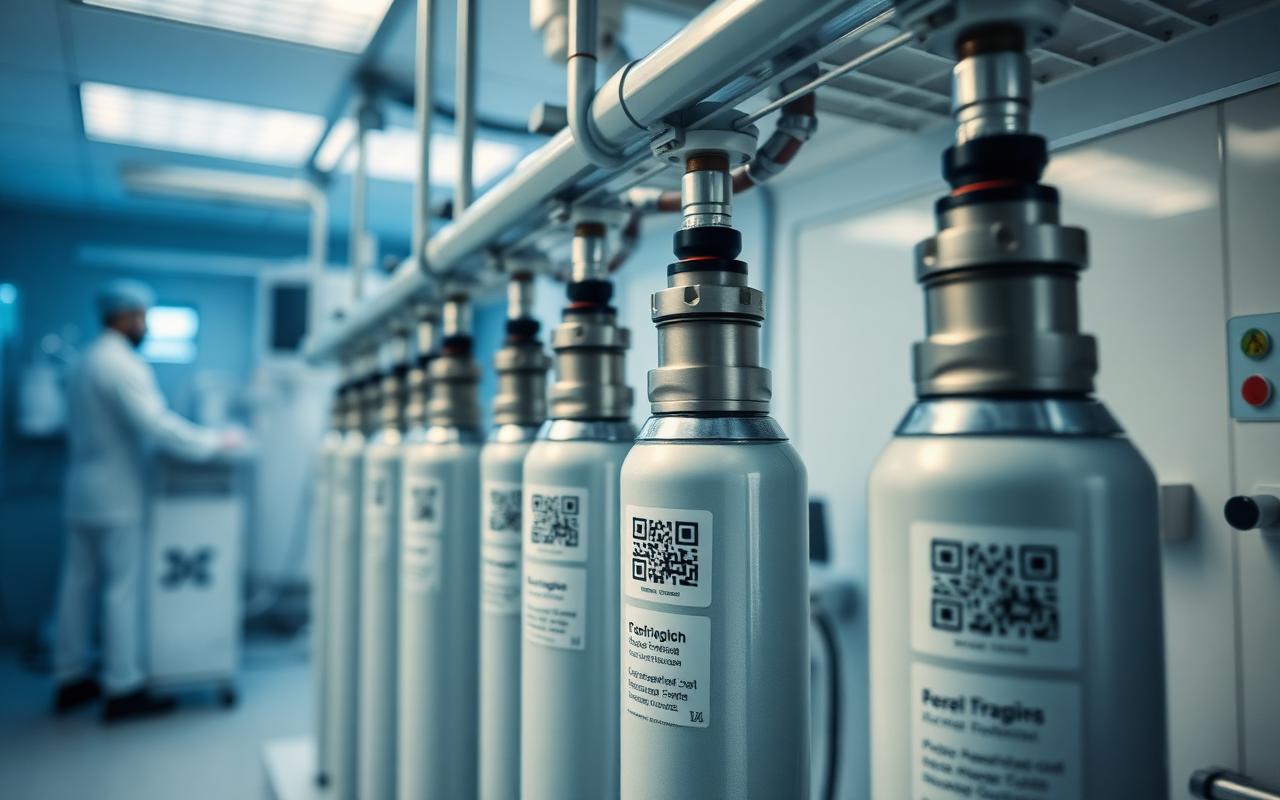
This is why any organisation serious about predictive maintenance needs to get its identification and tracking layer right first. Whether that means barcode labels for low-cost, high-volume identification, QR code tags for smartphone-based field scanning, or RFID for bulk, hands-free reads at gates and dock doors, the goal is the same: every meaningful event in a cylinder's life should generate a timestamped, location-stamped record. A gas cylinder tracking platform that captures fill, dispatch, delivery, return and testing events consistently is what turns a fleet of steel containers into a fleet of data-generating assets.
Once that scan trail exists, adding IoT sensors — pressure transducers, smart valve caps, GPS trackers on high-value cryogenic vessels — enriches the dataset further. Sensor telemetry captures things scanning alone cannot: how fast a cylinder's pressure is dropping, whether it experienced a shock event during transit, whether ambient temperature exceeded safe thresholds. For a deeper look at how sensor data flows into the tracking stack, see IoT in cylinder tracking.
A comparison: calendar-based vs. predictive maintenance
| Dimension | Calendar-based maintenance | AI-driven predictive maintenance |
|---|---|---|
| --- | --- | --- |
| Scheduling basis | Fixed interval per regulation | Usage intensity, condition signals, and interval |
| Risk prioritisation | None — all cylinders treated equally | Ranked by likelihood of near-term issue |
| Data requirement | Minimal — test date records | Consistent scan trail plus optional telemetry |
| Loss prevention | Reactive, after cylinder is missing | Proactive, flags unusual dwell/movement early |
| Fleet sizing decisions | Manual estimation, often lagging | Forecast-driven, months ahead of demand |
| Cost profile | Predictable but often wasteful (early tests) | Lower waste, but requires upfront data investment |
| Implementation effort | Low | Moderate — depends on tracking maturity |
The economics: where the savings actually show up
Predictive maintenance pays for itself through several distinct, measurable channels rather than one single dramatic saving:
- Fewer premature tests. Cylinders that are clearly under-stressed can safely defer testing within regulatory limits, freeing test bay capacity and reducing cylinder downtime.
- Fewer missed compliance windows. Risk-ranked alerts catch the cylinders genuinely approaching a compliance boundary, reducing the odds of a fine or a shutdown order during audit.
- Reduced shrinkage. Cylinders flagged for unusual dwell time get a follow-up call weeks earlier than they would in a manual review cycle, recovering assets that would otherwise be written off. This complements a broader loss prevention program.
- Better working capital use. Fleet-sizing forecasts prevent both the cost of idle capital tied up in excess cylinders and the lost sales from stockouts during demand spikes.
- Lower emergency logistics cost. Anticipating demand peaks means fewer last-minute, high-cost cylinder transfers between depots.
None of these savings require a large data-science investment on the customer's side — they are delivered as features inside the tracking platform, through the Cylinder Analytics solution, rather than as a custom machine-learning project each operator has to build.
Implementing predictive maintenance: a phased approach
- Audit your current data trail. Identify every point where a cylinder changes location, ownership or state, and confirm whether a scan or sensor event is captured there today. Gaps in the trail are gaps in future predictions.
- Standardise identification. Decide on barcode, QR or RFID (or a mix) per asset class and ensure every cylinder in the fleet carries a durable, machine-readable identity. Explore the Cylinder Barcode Software and Cylinder RFID Software options depending on your throughput needs.
- Consolidate historical data. Even a year or two of consistent scan history is enough to seed useful predictive models. Migrate legacy spreadsheets and paper logs into the central platform before go-live.
- Turn on baseline analytics first. Before chasing advanced predictions, get simple dashboards working — overdue tests, ageing cylinders, top-loss customers. This validates data quality and builds internal trust in the numbers.
- Introduce risk-ranked alerts. Once baseline reporting is stable, enable prioritised recommendations for testing and loss-risk follow-up, starting with a single plant or depot as a pilot.
- Layer in IoT telemetry selectively. Instrument your highest-value or highest-risk cylinder classes first — bulk cryogenic vessels, high-turnover industrial cylinders — rather than trying to sensor the entire fleet at once.
- Review and retrain quarterly. Usage patterns shift with seasons, customer mix and new contracts. Revisit model outputs regularly with operations staff who can sanity-check the recommendations against ground truth.
What AI cannot do — and why that matters
It's worth being direct about the limits. AI predictive maintenance does not replace regulatory testing intervals; it prioritises within and around them, and any jurisdiction's mandatory retest date remains a hard floor, not a suggestion. It also cannot compensate for fundamentally broken data collection — if half your cylinders never get scanned on return, no algorithm will produce trustworthy loss predictions for that half of the fleet. And it is not a substitute for physical inspection; a model can tell you where to look first, but a qualified technician still has to look.
Being upfront about these boundaries actually strengthens the business case, because it keeps expectations realistic: the goal is better-informed decisions and earlier warnings, not a fully autonomous maintenance department.
Building organisational trust in AI-driven recommendations
One of the most underestimated challenges in rolling out predictive maintenance is not technical at all — it is cultural. Maintenance supervisors, test bay technicians and compliance officers have often spent years relying on their own judgment and paper logs. When a system suddenly tells them to prioritise cylinder batch 47 over batch 12, despite batch 12 having an earlier calendar due date, the instinct is skepticism. Overcoming that skepticism requires transparency rather than blind trust. The best implementations expose the reasoning behind each recommendation — usage frequency, dwell time anomalies, pressure cycling history — rather than presenting a bare ranked list with no explanation. When technicians can see why a cylinder was flagged, they start treating the system as a second opinion worth listening to rather than an opaque directive from head office.
This transparency also matters for audits. Regulators and internal quality teams increasingly expect documented justification for any deviation from a strict calendar schedule. A predictive system that logs its reasoning alongside every recommendation gives compliance teams exactly the audit trail they need to defend early or deferred testing decisions, which strengthens rather than weakens the overall compliance posture.
Change management for maintenance and field teams
Rolling out predictive alerts successfully depends on how they are introduced to the people who will act on them daily. A phased communication approach tends to work best:
- Start with a shadow period. Run the predictive recommendations alongside the existing calendar-based schedule for several weeks without changing anyone's actual workflow, simply comparing outcomes.
- Share early wins publicly. When a flagged cylinder is confirmed to have a genuine issue ahead of its calendar date, or a flagged loss-risk cylinder is recovered because of an early follow-up call, circulate that story internally. Concrete examples build trust faster than abstract statistics.
- Give supervisors override authority, and track when they use it. Allowing a human to override a recommendation, and reviewing those overrides periodically, both respects field expertise and generates useful feedback for refining the model.
- Tie incentives to outcomes, not compliance with the tool. Reward reduced losses and fewer missed test windows, not simply "following the AI," so staff stay focused on the underlying goal rather than treating the system as a box-ticking exercise.
Industry-specific applications worth highlighting
Predictive maintenance delivers different value depending on the type of gas operation involved. In medical gas supply chains, where chain-of-custody and uptime are both critical, predictive alerts around cylinders approaching pressure or usage thresholds help hospitals avoid last-minute cylinder swaps during patient care. In industrial gas operations with high cylinder turnover across multiple customer sites, predictive loss-risk scoring is often the single highest-value feature, since industrial fleets typically lose a measurable percentage of cylinders annually to customer sites that simply never return them. In the LPG industry, where seasonal demand swings dramatically, fleet-sizing forecasts driven by historical order and weather data help distributors avoid both costly overstock during off-peak months and painful stockouts during winter demand spikes. And for cryogenic vessel operators, sensor-driven condition monitoring is particularly valuable because cryogenic equipment failures tend to be more costly and more safety-critical than standard cylinder issues.
Measuring the success of a predictive maintenance rollout
Before declaring a predictive maintenance pilot successful, define measurable success criteria upfront rather than relying on general impressions. Useful metrics include the percentage reduction in missed test windows over a comparable prior period, the recovery rate of cylinders flagged for loss risk compared to a control group that received no early follow-up, the change in average cylinder dwell time at customer sites, and the reduction in emergency stock transfers between depots during peak demand periods. Reviewing these metrics quarterly, alongside the maintenance and compliance teams who act on the recommendations daily, keeps the program grounded in real operational impact rather than becoming a dashboard that looks impressive but changes nothing on the ground.
Frequently asked questions
Does predictive maintenance require replacing our existing tracking system? No. It is typically an added analytics layer on top of the tracking and lifecycle data you already collect. If your current system captures fill, dispatch, delivery and return events consistently, you already have the raw material to start.
How much historical data do we need before predictions are useful? Meaningful patterns often emerge from twelve to twenty-four months of consistent scan history, though basic risk-ranking (like flagging overdue tests) can work from day one using rules-based logic while the fleet builds up richer history.
Is IoT telemetry mandatory for predictive maintenance to work? No. Scan-trail data alone — location, timestamp and event type — supports a useful first tier of predictions, particularly around loss risk and test scheduling. Telemetry adds a second tier of precision for condition-based alerts but is not a prerequisite.
Will this replace our compliance team? No. It makes their job more efficient by pointing them at the highest-risk assets first, but the judgment calls, documentation and regulatory sign-off remain human responsibilities, supported by the cylinder compliance workflows in the platform.
How do we know the predictions are trustworthy? Start by validating the model's outputs against known outcomes — cylinders it flagged as loss-risk last quarter, compared against which ones were actually recovered late or written off. Trust should be earned through track record, not assumed from day one.
Predictive maintenance is ultimately not a single feature you switch on, but a maturity level your tracking operation grows into once the fundamentals — consistent identification, disciplined scanning, clean master data — are in place. If your fleet is generating a reliable data trail today, the next step is turning that trail into foresight. Talk to the GCT team through a demo to see how AI-driven prioritisation works on your own cylinder data, or contact us to discuss where your fleet currently stands on the path from reactive to predictive.
Explore related GCT software
Put the ideas in this article into practice with the GCT modules and technologies built for it.
Run a smarter cylinder fleet with GCT
GCT gives gas companies barcode, QR & RFID tracking, automated billing, compliance dashboards and a mobile field app — all in one platform.
Running an enterprise gas distribution operation? Explore the Cylinder Tracking Management System at ctmsgas.com for enterprise-grade cylinder ERP deployments.