
How to Reconcile Cylinder Inventory Accurately
Reconciliation is the process of making your system's cylinder count match physical reality on the ground, and it is one of the most revealing exercises a gas distribution business can run. When a reconciliation cycle closes quickly, with few variances and clear explanations for each one, it tells you your tracking discipline is healthy. When it drags on for weeks and turns up hundreds of unexplained gaps, it is telling you precisely where your operational processes are leaking cylinders, money and customer trust. This guide walks through why counts drift in the first place, how to build a repeatable reconciliation cadence, and how to use variance data as a management tool rather than a once-a-year fire drill.
What reconciliation actually means for a cylinder fleet
Unlike a warehouse full of static SKUs, a cylinder fleet is a constantly moving asset base. Cylinders leave the plant full, sit in distributor yards, travel on delivery trucks, arrive at customer sites, sometimes get transferred between customers informally, and eventually come back empty for refill — if they come back at all. Reconciliation is the discipline of periodically freezing that motion long enough to compare what your system of record says should exist at each location against what is physically present. Any business running a Cylinder Inventory Software platform will eventually face this exercise, but the quality of the underlying data determines whether it takes an afternoon or a month.
The stakes are higher than most operations teams initially assume. Cylinders are capital assets — a single high-pressure industrial cylinder can cost several thousand rupees to replace, and a fleet of tens of thousands of units represents a significant balance-sheet investment. Beyond replacement cost, an unreconciled fleet hides deeper problems: cylinders sitting idle at customers well past their rental term, cylinders that failed a hydro-test and were quietly pulled from circulation without being retired in the system, and cylinders that were scrapped for damage but still appear as "available" in your reports, undermining demand planning.
Why counts drift in the first place
Drift rarely happens because of one dramatic event. It accumulates from dozens of small process gaps that compound over months.
- Cylinders returned but never scanned in. A driver drops off empties at the yard at the end of a long shift and the scan step gets skipped because it feels like extra work after a twelve-hour day. The cylinder is physically home but the system still shows it "at customer."
- Manual ledger entries with typos. Any process that still relies on a paper register or a spreadsheet invites transcription errors — a digit swapped in a cylinder serial number silently creates a phantom record and a missing record simultaneously.
- Cylinders at customer sites with no due-back tracking. Without a rental term and an automated reminder, cylinders can sit at a customer for years, and nobody notices until an audit forces the question.
- Damaged or scrapped cylinders never retired in the system. A cylinder that fails visual inspection or hydro-testing should be immediately flagged and removed from the active pool, but in many yards this step is informal and undocumented.
- Inter-branch transfers that bypass the system. When one depot lends cylinders to another to cover a shortfall, the transfer is often handled by a phone call rather than a recorded movement, and the receiving branch's count balloons while the lending branch's count silently shrinks on paper only.
- Refill partners and third-party fillers. Cylinders sent out for filling to a partner plant, especially in LPG or industrial gas networks, frequently get lost in reconciliation because the sending and receiving systems are not integrated.
- Customer-to-customer cylinder swaps. In some industries, especially small industrial gas users, empty cylinders get informally exchanged between neighbouring businesses without either party notifying the supplier.
Each of these looks small in isolation, but across a fleet of thousands of cylinders moving daily, they add up to material variance within a single quarter if left unmanaged.
A repeatable reconciliation process
The single biggest mistake operations teams make is treating reconciliation as an annual, all-hands, shut-down-the-yard event. That approach is exhausting, error-prone, and by the time it uncovers a variance, the root cause is months old and impossible to trace. A better approach borrows from cycle counting practices used in warehouse management and applies them continuously.
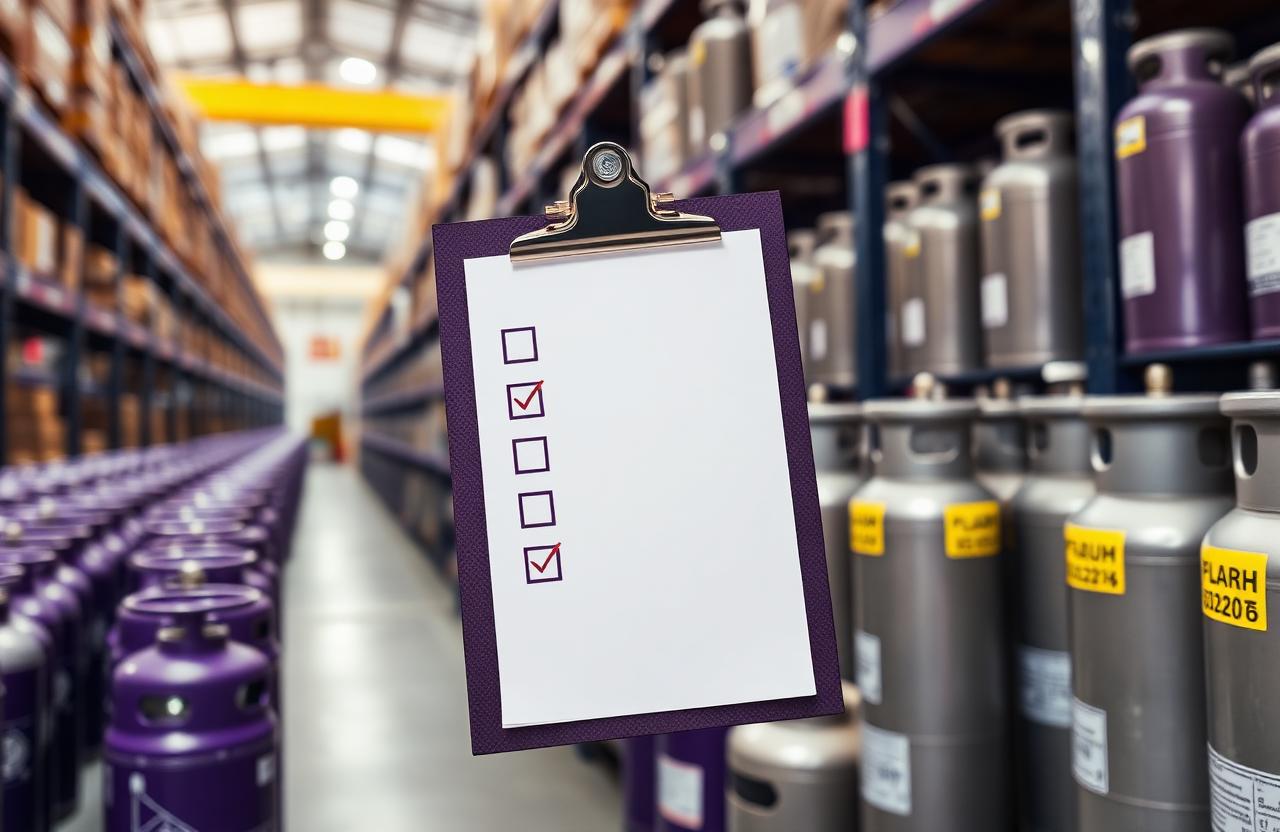
- Freeze a cut-off. Pick a specific date and time for the count and communicate it clearly to every team touching cylinders — drivers, yard staff, customer service, and filling operators. No movements should be logged as happening "around" that time; they are either before or after.
- Scan the physical yard. Every cylinder physically present must be captured using a mobile scanner, not written down on a clipboard. This is where a proper Driver Mobile App or handheld scanning tool pays for itself many times over, because it timestamps and geotags each scan automatically.
- Pull the system's "should-be-here" list. Generate a report of everything the system believes should physically be at that location — meaning everything not marked as dispatched, at-customer, in-transit, or already scrapped.
- Compare and categorise variances. Every mismatch falls into a bucket: genuinely at a customer site with valid documentation, in transit between locations, lost with no trace, or scrapped but not yet retired in the system. Resist the temptation to lump everything into a generic "unaccounted" category — the categorisation itself is the diagnostic value of the exercise.
- Resolve and record. Update statuses to reflect reality, and — critically — write down the root cause for each variance rather than just correcting the number. A spreadsheet cell that silently changes from 1,204 to 1,187 teaches you nothing; a note that says "17 cylinders confirmed scrapped after Q2 hydro-test failures, not retired in system" teaches you where the process broke.
Running this cycle monthly for a subset of locations, on a rolling basis, spreads the workload and catches problems while they are still fresh enough to investigate. Annual, big-bang reconciliations should become a formality that confirms what the monthly cycles already told you, not a surprise-generating exercise.
The role of technology in shrinking the reconciliation burden
Manual reconciliation is painful precisely because it relies on humans remembering or re-verifying information that should have been captured automatically at the moment it happened. A cylinder tracking platform built around barcode, RFID, or QR code identification removes most of the guesswork by making every movement — fill, dispatch, delivery, return, transfer — a scan event with a timestamp, a location, and an operator ID attached.
| Manual paper/spreadsheet process | Digital scan-based process | |
|---|---|---|
| --- | --- | --- |
| Movement capture | Written at end of shift, prone to memory gaps | Captured instantly at point of scan |
| Variance visibility | Only discovered during periodic audits | Visible in near real time on dashboards |
| Root cause traceability | Requires interviewing staff, checking multiple logs | Full audit trail with timestamps and user IDs |
| Time to reconcile 10,000 cylinders | Days to weeks | Hours |
| Confidence in "should-be-here" count | Low, frequently contested | High, backed by scan history |
| Customer disputes on quantities | Common, hard to resolve | Rare, resolved with scan evidence |
A platform such as a full Gas Cylinder Tracking Platform does more than record scans — it enforces the workflow so that a driver cannot close out a delivery route without confirming returns, and a yard supervisor gets an automatic exception alert if a truck arrives with a different cylinder count than the dispatch note specified. This turns reconciliation from a retrospective forensic exercise into a live control that prevents most variances before they happen.
Enforcing scan discipline without slowing operations down
Technology alone does not fix reconciliation if scanning is optional or inconvenient. The operations teams that get the best results treat scan-in and scan-out as non-negotiable steps built into the workflow, not an add-on task.
- Make scanning part of the physical handover, not a separate paperwork step done later at a desk.
- Use rugged, weatherproof labels so scan failures due to damaged codes do not become an excuse to skip the step — see our comparison of label technologies for guidance on durability trade-offs.
- Give drivers a mobile app that works offline and syncs later, so poor connectivity in rural delivery areas never becomes a reason to skip scanning.
- Build in a hard stop: a route cannot be marked "complete" in the system until every cylinder on the manifest has either a delivery scan or an explicit exception reason.
- Retire scrapped cylinders within the same shift they fail inspection, not at the end of the month, so your active count never carries phantom assets.
- Track cylinders held at customer sites with a due-back date and automated reminders, integrated with your Cylinder Rental Software so overdue returns generate a follow-up task automatically rather than relying on someone remembering.
Turning variance data into a management tool
The organisations that benefit most from reconciliation are the ones that stop treating it as a compliance chore and start treating it as a diagnostic report on their operations. Once you have several reconciliation cycles behind you, trend the results rather than just filing them away.
Look at variance rate over time as a single headline metric — total variance divided by total fleet size, tracked monthly. A shrinking trend confirms your process improvements are working; a plateau or increase is an early warning that something has changed, whether that is staff turnover, a new route, or a new customer segment with different return habits.
Break variances down by branch, by route, and by customer. In most fleets, loss is not evenly distributed — a small number of routes or customer accounts typically account for a disproportionate share of unexplained gaps. Once you can see that concentration, you can target training, contract terms, or even security measures at the specific pain points rather than applying a blanket policy across a fleet that is mostly performing well.
Segment by cylinder type and gas category too. High-value cryogenic or specialty gas cylinders often warrant tighter tracking than common industrial cylinders, and reconciliation data will tell you which categories are most exposed to loss.
Feed this data into your analytics layer. A platform with a proper Cylinder Analytics module can automatically flag customers whose average dwell time is creeping upward, or routes where returns consistently fall short of dispatches, long before the next scheduled reconciliation cycle catches the pattern manually.
Reconciliation as part of a broader loss-prevention strategy
Reconciliation is a detection mechanism, not a prevention mechanism on its own — it tells you loss has happened, not how to stop it happening again. Pair it with a genuine Cylinder Loss Prevention strategy that addresses the root causes uncovered during reconciliation: contract clauses for extended holding of cylinders, deposit structures that create a financial incentive for customers to return cylinders promptly, and route-level accountability so drivers are measured on return rates as well as delivery speed.
It is worth noting that reconciliation accuracy also directly affects compliance reporting. In regulated segments like Medical Gas and Industrial Gas, auditors and regulators expect a defensible chain of custody for every cylinder, and a fleet that cannot reconcile its physical stock against its records struggles to demonstrate that chain convincingly during an inspection.
Common pitfalls that undermine reconciliation efforts
Even well-intentioned reconciliation programmes fail for predictable reasons. Watch for these traps:
- Treating reconciliation as a once-a-year event. By the time a single annual count uncovers a discrepancy, the transaction that caused it may be twelve months old, and nobody remembers the details needed to investigate it properly.
- Counting without categorising. A raw variance number without root-cause categorisation tells you that something is wrong but nothing about what to fix.
- No ownership of variance resolution. If nobody is explicitly accountable for chasing down each unresolved variance, the "pending investigation" list simply grows every cycle without ever shrinking.
- Ignoring small, recurring variances. A five-cylinder gap at the same branch every month is far more informative — and often easier to fix — than a one-off two-hundred-cylinder discrepancy caused by a data migration error.
- Relying on the same team that made the errors to also verify them. Wherever practical, have someone outside the day-to-day operations team spot-check a sample of the physical count against system records.
How often should you reconcile
There is no single universal answer, but a reasonable framework scales the frequency to risk and volume. High-turnover branches handling perishable or high-value cylinder categories benefit from weekly spot-checks on a sample basis and a full count monthly. Lower-volume branches or long-dwell-time asset categories can reconcile quarterly without much risk of drift becoming unmanageable. What matters more than the exact cadence is consistency — a process that runs reliably every month, even if imperfect, will always outperform a perfect process that only runs once a year.
Frequently asked questions
How long should a reconciliation cycle take for a mid-sized fleet? For a fleet in the low thousands of cylinders with digital scan-based tracking already in place, a full reconciliation cycle typically takes a few hours of physical scanning plus a day or two of variance investigation. Fleets still relying on manual registers can expect the process to take several days to weeks.
What variance rate should we consider acceptable? There is no universal benchmark, but most well-run fleets using digital tracking bring unexplained variance below one percent of the active fleet within a year of implementation. Anything consistently above five percent usually indicates a fundamental process gap rather than isolated incidents.
Should customers be involved in reconciliation? Yes, particularly for customers holding cylinders on long-term rental. Sharing a simple statement of cylinders currently held, generated automatically through a Customer Portal, reduces disputes significantly because both sides are working from the same real-time data rather than reconstructing history after the fact.
Can reconciliation be fully automated? The comparison step between system records and physical scans can be fully automated, and modern platforms generate the variance report instantly. The physical scanning itself and the judgment calls involved in categorising ambiguous variances still require human oversight, though RFID-based bulk scanning can dramatically speed up the physical count portion.
What is the difference between reconciliation and an audit? Reconciliation is the routine, operational process of matching counts and resolving day-to-day discrepancies. An audit is typically a more formal, often externally reviewed, verification exercise — sometimes required for compliance or insurance purposes — that draws on your reconciliation history as supporting evidence.
Building reconciliation into your long-term strategy
The businesses that reconcile with the least pain are not the ones with the fewest cylinders or the simplest operations — they are the ones that made scanning, status updates, and exception handling part of the default workflow rather than an afterthought. If your team still dreads the monthly or annual count, that dread is a signal that the underlying data capture process needs investment, not that reconciliation itself is inherently painful.
If you are ready to move from firefighting reconciliation to a system where counts stay aligned automatically, explore how a connected Cylinder Inventory solution can eliminate most manual reconciliation work by capturing every movement as it happens. Book a demo with our team to see how GCT handles reconciliation for fleets of every size, or contact us to discuss your current process and where the biggest gains are likely hiding.
Explore related GCT software
Put the ideas in this article into practice with the GCT modules and technologies built for it.
Run a smarter cylinder fleet with GCT
GCT gives gas companies barcode, QR & RFID tracking, automated billing, compliance dashboards and a mobile field app — all in one platform.
Running an enterprise gas distribution operation? Explore the Cylinder Tracking Management System at ctmsgas.com for enterprise-grade cylinder ERP deployments.